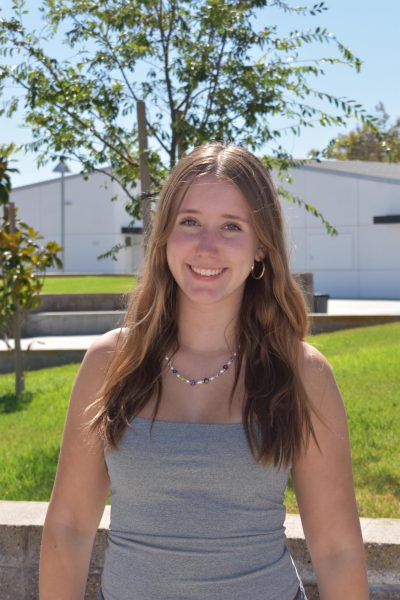


When Mariana* (11) was at the lowest point of her life, she found comfort in a different way than most do. She had grown up watching Olivia Rodrigo on Disney Channel and was intrigued when Rodrigo released her debut album SOUR in 2021. From then on, her infatuation with Rodrigo developed into something stronger than a typical fan relationship.
“I started liking [Rodrigo] because her shows were a really big part of my childhood growing up, so I was familiar with who she was before she came out with any music,” Mariana said. “When her debut album started getting popular, I was like, ‘Yeah, that’s my girl’ and knew that I could find that community in people who liked her too. I’ve loved her ever since then. I’m a really big fan of her and her music. It helped me through a really dark time in my life so I think that’s why I feel so connected to her. She was there for me when nobody else was.”
Clinical psychologist and Professor of Psychology at the University of Richmond Janelle Peifer Ph.D. said that on occasion, this behavior crosses into a realm where it is labeled as a parasocial relationship. A parasocial relationship is a non-reciprocal relationship between a fan and a celebrity, fictional character, or other figure with whom the person cannot form a genuine tangible relationship. However, because of the evolution of social media, the definition is ever-changing, according to Peifer.
“The reason why that definition evolves is because the way that media has been consumed is also evolving,” Peifer said. “While there used to be more of a buffer between celebrities and non-celebrity viewers or audience members, that was more impenetrable and difficult to cross. Now, there are more opportunities for exchange via social media and spaces like that. Some of the manifestations in modern forms, people very much feel that they are close with, are invested in, and care about people who they have never met in real life or outside of the social media or technological spheres.”
Mariana said she felt an unusually deep connection to Rodrigo after listening to the vulnerability demonstrated in her music.
“I just felt like someone else is feeling the same things as me,” she said. “It was really validating at that time, and I think my relationship with her just blossomed from there. I can’t imagine a life without [Rodrigo] in it, I just feel like she fulfills this side of me that nobody really understands.”
Peifer said that this unclear boundary and frequent exposure make it harder for people to psychologically distinguish the limits of their relationships with online figures. Fans become well-versed on these celebrities’ behavior to the point that they feel close to them, causing them to feel more connected.
“Through social media, it gets a little bit more complex because the people whom you are observing are existing right alongside people with whom you have reciprocal relationships with on a daily basis,” Peifer said. “So you might see on your feed videos from your friends and from your sister right alongside videos from a celebrity who you’ve been following.”
Mariana said that because of her adoration for Rodrigo, she follows multiple fan accounts on social media, exposing her to an overwhelming amount of content about the singer.
“I’ve seen probably close to everything she’s ever put on the internet,” Mariana said. “The way she interacts with us, her fans, is very friendly. I kind of view her posts differently than most other celebrities because I’m so knowledgeable about who she is and stuff, that it feels more personable because I can kind of envision the process of posting it. It sounds a little odd but, I know her favorite color and stuff about her life so she does in a way feel like a close friend.”
Aiden* (10) struggled with a similar issue in his past. As a long-time fan of the Seattle Seahawks, he said growing up in a family that was passionate about sports affected his perception of what it means to be a fan.
“I didn’t really realize how much of an impact it had on me until I started talking about it to people and they were like, ‘Hey, that’s lowkey weird,’” Aiden said. “I played youth football and would model my playing style off of the Seahawks guys and stuff like that. I knew it was bad when I’d be genuinely upset when they would lose. It would ruin my day and sometimes my whole week.”
Aiden said he would often sacrifice his real life for the one he had created online.
“I used to always center my days and schedule and stuff around the games and interviews and things like that,” Aiden said. “I didn’t hang out with friends when they’d invite me out because I thought the game was a lot more important and so I missed out on a lot of social stuff. One time I even missed church because the game was really early in the morning so I stayed home and watched it because that was the priority. I’ve always been kind of shy so having that community, especially online, was good because I didn’t really have to make friends. They were kind of given to me. It felt safer, but now I would prefer my real-life friends over anyone who I followed or talked to online.”
This issue has become increasingly common with the rising popularity of social media, contrasting the manifestations of parasocial relationships with the era before social media, according to Peifer.
“Historically in early television, people would feel that newscasters were speaking directly to them,” Peifer said. “There was a lot more belief that these parasocial relationships were rooted in thought disorders. But now, [parasocial relationships] are much more common because of media exchanges. It looks like a celebrity is talking to you–they’re offering to interact with you, you can DM them, you could read everything about their life. So the barrier that used to be more impenetrable before is now a lot thinner.”
Mariana said she often turns to Rodrigo and her music as an escape from her reality.
“Whenever I feel upset or lonely I tend to go watch interviews or listen to her music,” Mariana said. “She just feels very comforting and familiar to me so I kind of look to her as a way to help me when I’m feeling down. It’s nice to feel like you have someone there who knows what you’re going through. And obviously we can’t have a conversation but if we did I know she’d know what to say. So it’s just a place of solace for me to kind of live in that space of comfort without having to really explain how I feel to anyone else.”
Peifer said there’s different warning signs to look out for to avoid falling into this obsession.
“When a parasocial relationship can cross a boundary from normal and healthy interactions to more maladaptive fixations or delusions, some of the things that you’re looking out for is, when does this start to replace other forms of interactions or experiences that are a part of your healthy functioning?” Peifer said. “It might be that it’s fun, it’s entertainment, it’s a diverting activity, but it’s not taking up a significant amount of time, not causing distress or dysfunction in any other relationships as well. It’s something that you’re aware of, but it’s not occupying a lot of space in your life in a way that crowds out other important experiences or leads to damage emotionally or physically where you’re putting yourself at risk when you find it’s difficult to do that ‘reality testing.’”
Peifer said that these exchanges aren’t formed solely by attraction or comfort. She said that the figures or characters that people form adaptive relationships with often reflect internal insecurities. She said this is often common amongst teens because of their susceptibility to mental instability and developmental insecurity.
“Oftentimes the people who we relate to or form parasocial relationships with tell us things about our own identity,” Peifer said. “What are you looking for from that person, and what might that tell you about who you are? There’s also the sense of escapism that can be put into play with those more adaptive parasocial relationships that might be something fun to distract your brain with a fantasy, things like imagining a world in which you are fabulously wealthy or have this ongoing relationship with somebody who has access to many resources and opportunities that might be withheld from most people or inaccessible to most. There’s lots of different cognitive and psychological mechanisms by which parasocial relationships can come to be.”
Aiden said while he used to just think he was a dedicated fan, his relationship with the team and the athletes grew to a point where he became concerned.
“It got to a point where I knew about every [player’s] personal life because of how much time I’d spend on it,” Aiden said. “I would keep up with stuff like that and let their victories and milestones in life kind of feel like my own because of how invested I was. I still really love the Seahawks obviously, but I had to kind of take a step back when it became too emotional for me. I didn’t think I should let a sports team dictate my own happiness, and some of my friends helped me kind of get to that point.”
Despite Mariana’s relationship with her favorite artist existing primarily on the internet, she said that fulfillment is enough for her.
“I love the friends I have in real life, they’re amazing,” She said. “But sometimes I’d rather turn to [Rodrigo’s] DM’s to vent or something because I know I won’t get judged there. When I talk to my friends I might not necessarily get the response I’m looking for and that can be hard.”
Peifer said that those with more emotional vulnerability are more susceptible to engaging in such behavior. Some parasocial relationships can mirror real-life interaction.
“This can also affect our brain at a neurological level, mimicking those real life interactions in a way that can be very confusing especially for vulnerable brains, people who might have thought disorders, difficulty with reality testing, or younger people who are developmentally in that stage,” Peifer said. “Or, [it’s confusing for] those who are very isolated, lonely, and who have a higher sort of drive and need for connection, but might have difficulties that get in the way and make those real life interactions more challenging.”
Mariana said Rodrigo’s openness on the internet has allowed her to get a glimpse into what her life truly looks like. She also said she believes that this situation has positively impacted her life.
“I don’t necessarily want to say I recommend having this kind of relationship, but for me I believe [Rodrigo] has genuinely saved me,” Mariana said. “I wish the stigma about liking an artist, especially as a teenage girl, wasn’t so negative because having her there for me has helped me and a lot of other people online I’ve talked to also. Just existing in the same space as her is a privilege and I know she loves her fans the way we love her.”
Despite acknowledging that forming genuine relationships can be difficult, Peifer said that not doing so can affect the ability to create relationships later in life.
“Social relationships in 2025 are extremely complex,” Peifer said. “Vulnerability requires the skills to navigate a lot of the unwritten rules of social relationships that can be chaotic and painful despite all of the benefits that can come along with them. So somebody seeking out [parasocial relationships] because they feel safer and less challenging means they are not necessarily developing the skill sets that can help make those social relationships more fruitful. Like anything else, especially during adolescence, we’re developing the template for later life relationships. And if you’re noticing that you’re retreating away from that, it might mean that it’s harder to build those connections in the long term.