
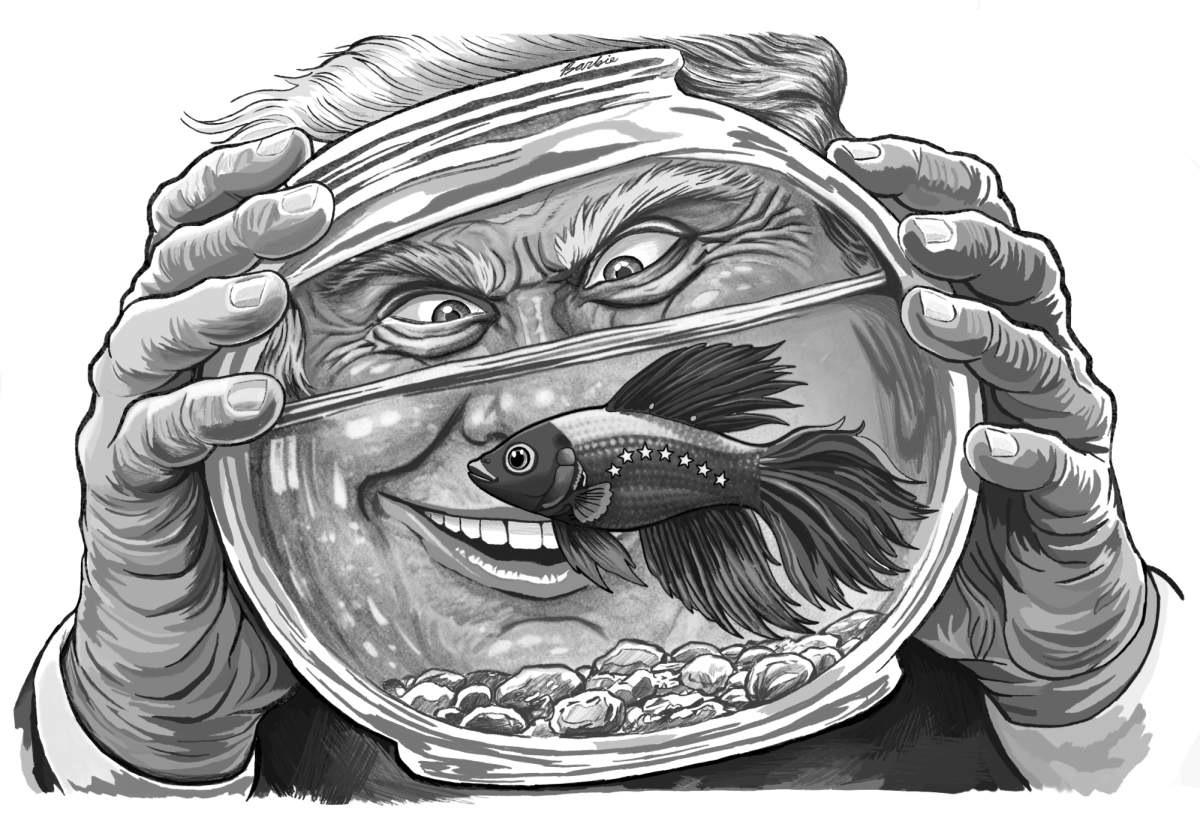
On Jan. 3, President Donald Trump announced that the U.S. had successfully carried out a large-scale strike against Venezuela and captured Venezuelan President Nicolas Maduro and his wife. Although this dictator was removed, our nation’s focus seems to be on supporting private sector businesses through the revenue generated in a foreign country we have illegally abducted power from.
The U.S. had been striking Venezuelan vessels since September, positioned as a mission to fight against the narcoterrorism in Latin America to the U.S.These actions alone were unlawful under U.S. and International Law. However, the administration went a step further, following with strikes within Venezuela and the kidnapping of Maduro and his wife. The Trump administration justified the capture as a militarily-supported law enforcement action.
Venezuela has the largest oil reserves in the world and produces a major part of global oil resources. By seizing the regime in the country, the U.S. can illegitimately take control of oil reserves under the state-owned Venezuelan oil sector, Petroleos de Venezuela, S.A.
A New York Times article published on Jan. 3 stated that the Trump administration will provide the generated revenue from the oil directly to private U.S. oil companies, as well as to “the United States of America in the form of reimbursement for the damages caused by that country.”
The Maduro administration has been globally criticized for its authoritarian rule since 2013, when Nicolas Maduro was appointed by the former president Hugo Chavez. Under Maduro’s rule, Venezuela has faced extreme humanitarian crises. According to Amnesty International, around 8 million Venezuelans have fled the country out of fear and despair at its political and social conditions. Poverty levels are still on the rise, with drinking water and electricity becoming scarce. Protests are being violently repressed with excessive use of force and possible extrajudicial executions..
Democracy in Venezuela is not the only thing that is threatened. UN Charter article 2(4) states “All Members shall refrain in their international relations from the threat or use of force against the territorial integrity or political independence of any state, or in any other manner inconsistent with the Purposes of the United Nations.” When the Charter is violated, the use of force is considered an act of aggression or war. There are two legal justifications for acts of war under UN Charter Article 51, and Chapter VII: self-defense and UN authorization. According to Geoffrey Robertson KC, the former president of the UN war crimes court, this act of war cannot be justified as self-defense, as there was no imminent harm or threat of harm present from the Venezuelan side. On top of that, the United Nations did not authorize these attacks. Even within the United States, the Monroe or “Donroe” Doctrine, does not guarantee a Constitutional right of the president to act on foreign intervention.
This violation of international law sets a dangerous precedent globally. In the UN, the United States has veto power, meaning even if consequences by sanctions were imposed upon the nation, it could simply veto the decision and impair the security council of the UN. By dismantling the security council, more invasions and acts of violence like these could happen around the globe. Additionally, the U.S. intervention in Venezuela, according to Robertson, is essentially the same crime Russia committed when invading Ukraine.
It is difficult to know what will happen next. However, there are two things that are more certain than others. First, the Venezuelan authoritarian rule has not been defeated yet. President Trump has shown willingness to work with Delcy Rodriguez, the current Venezuelan president, which indicates little to no change to the people in office. The same administration that allowed Maduro’s dictatorship will continue its rule. Second, this might not be the last direct foreign involvement from the United States. President Trump expressed a desire for similar pressure on Colombia, recently sanctioning Colombian President Gustavo Petro for alleged reluctance to combat drug trafficking. He also threatened Mexico and Cuba, saying that he required “more” from both nations to earn U.S. favor. And the infamous talk about annexing Greenland has recently been prevalent. It seems viable to assume that the attacks against Venezuela was a start of something that could turn into modern imperialism in the United States.