
In 1965, The Voting Rights Act (VRA) was passed by President Lyndon B. Johnson in response to the widespread voter suppression minority voters were subjected to in the South after the passing of the Thirteenth, Fourteenth, and Fifteenth Amendments. According to the US Department of Justice, the VRA made practices like literary tests, poll taxes, and discriminatory acts illegal, allowing the government power to oversee the election process more carefully and ensure that minorities were able to vote without restrictions.
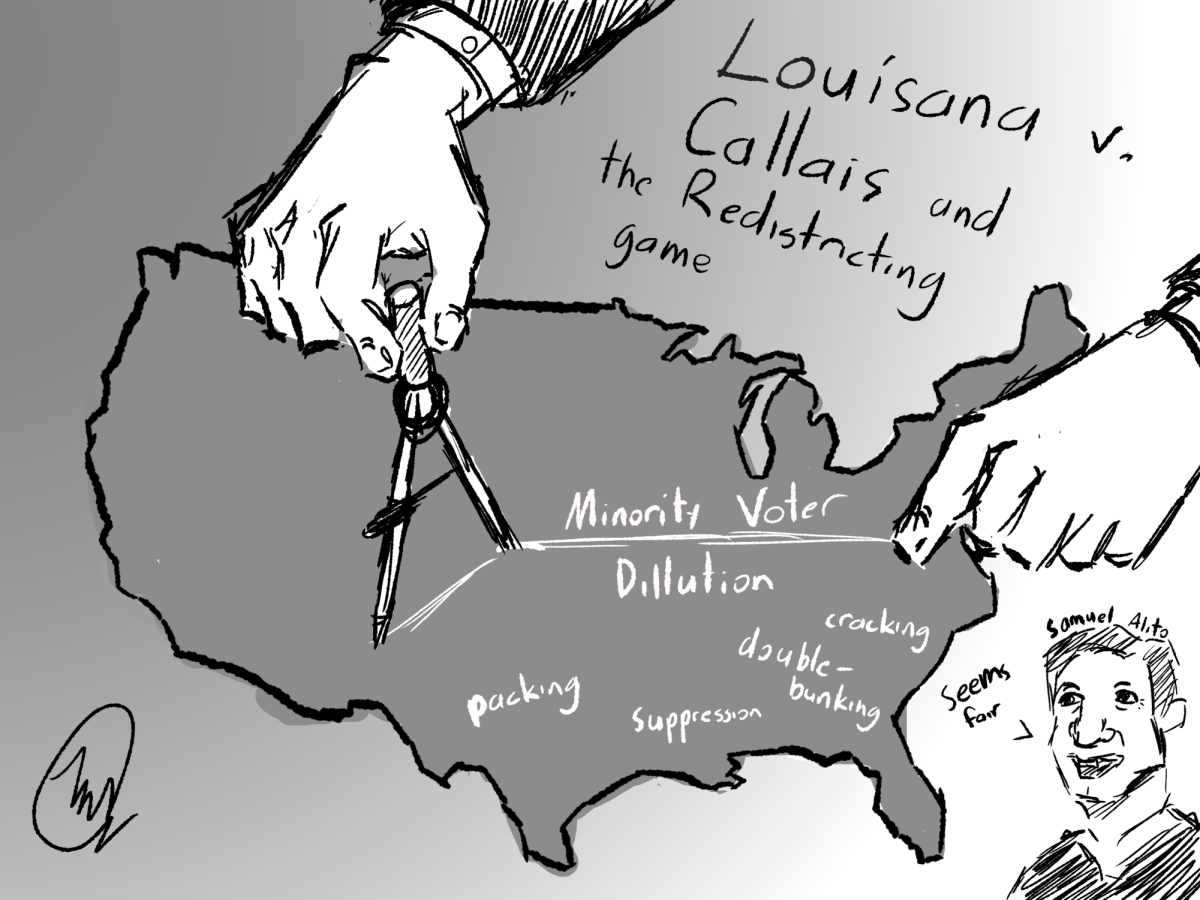
However, on April 29 of this year, a major section of the VRA was gutted by the Supreme Court’s decision in the Louisiana v. Callais case, which focused on Section 2 of the VRA. This section was dedicated to prohibiting minority voter dilution. Minority voter dilution occurs when electoral districts are drawn to concentrate a certain minority into one district, weakening their collective voting power by giving them one electoral vote instead of spreading their voices through multiple districts. According to a 2017 report from the Brennan Center for Justice, the number of Black and Latino representatives in Congress increased dramatically after the passing of the VRA, due to the use of majority-minority districts to resolve voter dilution in states.
When Louisiana redrew district lines in 2020, there was only one Black majority district in the state, despite the US Census Bureau reporting that over 30% of Louisiana’s population is considered Black. This disconnect led the National Association for the Advancement of Colored People (NAACP) and others to argue that the state was intentionally diluting the voting power of Black citizens through the redrawing of district lines. Louisiana redrew again to include another Black voter majority district, but the change was challenged by the case Louisiana v. Callais. According to the NAACP’s Legal Defense and Educational Fund (NAACP LDF), the case argued that the redistricting was racially motivated, violating the Equal Protections Clause of the Fourteenth Amendment. The court’s majority opinion from Justice Samuel Alito asserted that the redistricting was an unnecessary use of the VRA, and claimed that the 2020 redistricting was politically motivated, not racially motivated, as the districts were drawn to give political advantage to Lousiana Republicans. Although it’s true that the redistricting was politically motivated, an argument could be made to suggest that the 2020 redistricting wasn’t solely politically motivated, as political affiliation and race are intertwined. According to Split Ticket, only 7% of Black Louisianans voted Republican in the 2023 primaries, demonstrating how the redistricting could be both politically and racially motivated.
The majority opinion’s interpretation of the VRA narrows this caveat and instead argues that the section should be interpreted with a much shallower basis than previously thought. Louisiana v Callias’s ruling and the Court’s interpretation of Section 2 significantly weaken the section, hindering the ability to prevent future voting dilution and affecting minority representation in government.
According to an analysis from Harvard’s Kennedy School of Law, the case raises the burden of proof, or the requirement to provide evidence, for those challenging the Constitutionality of redrawn district lines, as they would now require a clearer separation between political and racial motivations. Now, plaintiffs must demonstrate that there’s a clear racial motivation behind the reduction of minority voting power, not political. This can be incredibly difficult to prove, as the motivation behind gerrymandering can be both political and racial. This standard will make Section 2 cases far more difficult to win.
Since the section has been weakened, it may become difficult for minority groups to achieve more representation, as states can gerrymander their districts as they please with less pushback. In the past two weeks, multiple southern states including Louisiana have rushed to redraw their district lines to break up majority Black districts, with Louisiana and Alabama both pausing their primary elections in order to do so, with little pushback.
The VRA remains intact, but Section 2’s effectiveness has been left up to interpretation, causing the VRA to be “hollowed out”. The court’s ruling leaves uncertainty surrounding how the VRA’s original function to provide representation in government is being fulfilled, if it at all, and intentional or not, demonstrates the devaluation of minority voices in our government.