
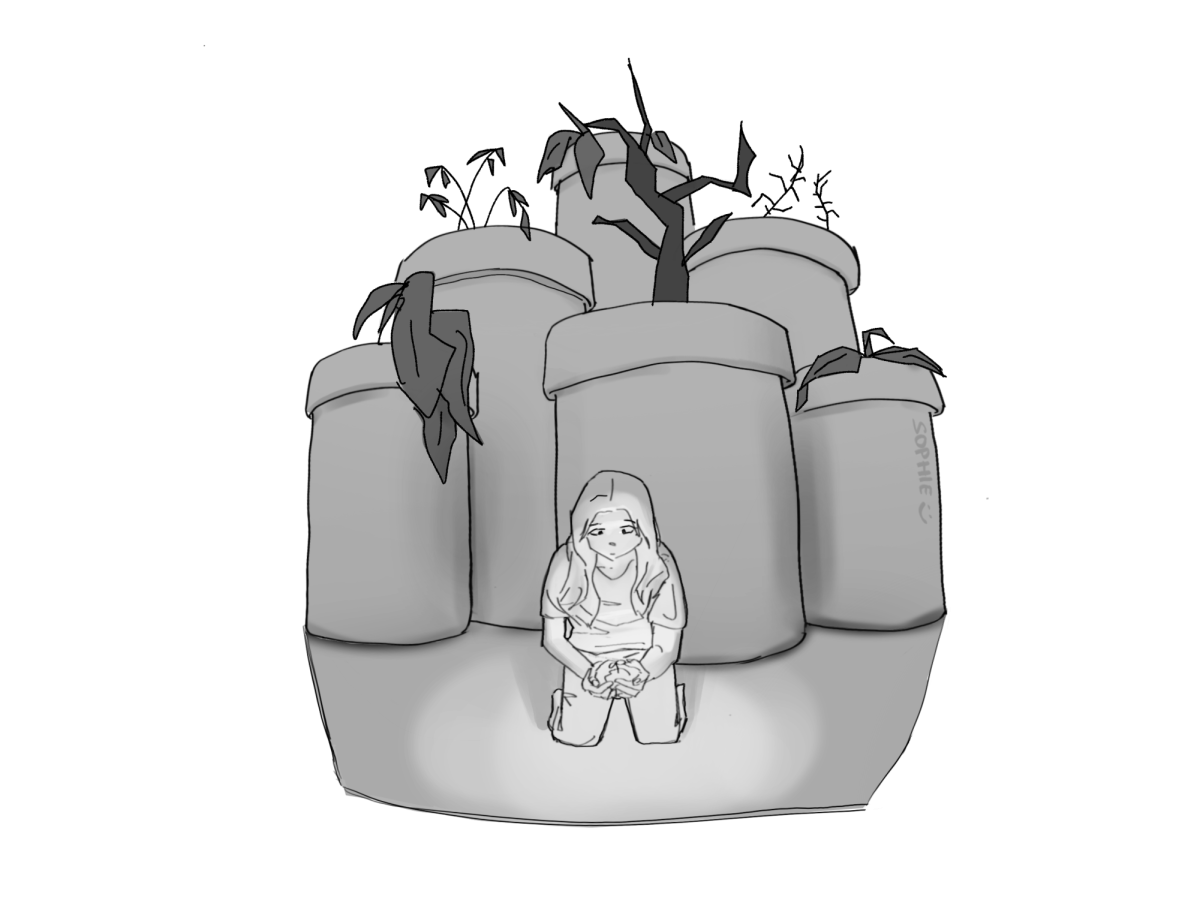
Today, I tell myself, I am going to write a poem. The sun has long since set, and I’m alone with the crickets and the white noise of a nearby highway—perfect conditions for poetry. I’m prepared like always: a desk lamp on my right, a notepad and red pen on my left, and an empty Google Doc in front of me, set to Times New Roman font size 12. But when I hover my fingers over the keyboard, it’s as if they are repelled like two south-facing magnets. I’ve been bled dry of words to write, so I sit in despondent silence as I feel the muscles of poetry begin to unravel.
I haven’t written a poem in six months. I used to write dozens in a week.
Though I used to be an ardent poet, I’ve hit an alarming poetry drought in recent months. Faced with the pressure for quantitative achievement as college applications drew near, I prioritized writing poetry for prizes, losing my authenticity and joy in the process. Now, I mourn the absence of poetry in my life as I attempt to rekindle my love for the art form as a whole—this time without weighing it down with external motivators.
I began writing poetry as an experiment in seventh grade. Drawn to the fluidity of it—in pleasant contrast to the rigidity of classic prose—I dabbled in free-verse as I pieced together loftily-crafted metaphors, empathic indents, and concerningly recurring slews of anaphoras. Poetry soon became a way for me to safely express my emotions and thoughts; inside my Google Docs and Notes App, I was free to write whatever I wanted, and that freedom brought me contentment that little else could. Poetry was my thing. It was just for me.
In my world, poems simply wrote themselves. All around me, poems were alive, begging to be written. Watching my father struggle to pry open a durian he bought for my mother was a poem, and so was listening to the birdsong of the two pigeons that made my apartment balcony their home.
But when I turned my attention to writing poems for tangible achievements, I lost the spark that poetry had given me. After attending a summer writing camp, I was left both inspired and petrified. My peers loved poetry as much as I claimed to, but they had awards to show for it. The Patricia Grodd Prize for Poetry, numerous Scholastic Art and Writing medals, and the coveted YoungArts Winner title. Until then, my poetry was just for me, but in the world I was now living, that wasn’t enough. I needed external validation. I wanted a reward. A prize. An honor.
Disillusioned, I returned from the camp with the sense of being fatally behind. With college applications just around the corner, I realized I had to do something about it. Scouring the Internet for writing competitions and literary journals, I wrote pieces mechanically, seeking to emulate the artistry of the winning pieces on the Scholastic website, the clever wordings of the myriad poems in the Kenyon Review. I knew that competition judges seemed to love pieces on fragmented identity, so I wrote about the difficulties of embracing my culture. I called upon classic motifs of a mother’s hands and home-cooked soup. I wrote poems I thought would win.
According to psychosocial rehabilitation specialist Kendra Cherry, extrinsic motivation is motivation that stems from outside sources, such as money, awards, and recognition. Though it can be a powerful motivating force, it can also lead to the overjustification effect, in which intrinsic motivation decreases as a result of the extrinsic.
Now, reading back on the poems I wrote for those competitions, I feel nothing. The poems are fine, objectively, but they fail to be what poetry has always been to me: a reflection of my truest conflictions, experiences, and realizations. Pieces of myself woven into words, commas and line breaks I’ve agonized over, metaphors that once were stuck in my throat. I’ve overjustified myself, forgoing the joys and authenticity of poetry because of my desperation to be recognized for it.
There are some things in life that mean more than just what they amount to on a resume. For me, poetry should have been one of those things. Until I forgot how important it was to me, it was. Now, I mourn its absence as my collection of publications grows—publications that mean nothing when poetry itself has abandoned me.
In the aftermath of the college application process, I’ve been left empty. A world that was once teeming with poems has grown stagnant, and I’m agonized at this integral part of my life that I’ve lost. Staring at an empty document is painful, and there are words I want to say, poems I want to write that simply refuse to tumble out from my mouth and onto paper.
Recently though, I’ve felt a whisper of it return. When reading a Wikipedia article (of all things), I had an idea for the opening line of a poem. Frantically, I wrote it out and began to write without thinking, praying something would spill out. My lines fizzled out halfway through the second stanza, but I smiled at how the page was filling up. It takes so little to make a poet happy.
My poetry hasn’t been lost for good. But now, it needs to be nurtured. I need to remember how it feels to write a poem simply to bask in the afterglow of it. To write because I want to. To create with no strings attached, because that’s what poetry—and any passion, really—is all about.