
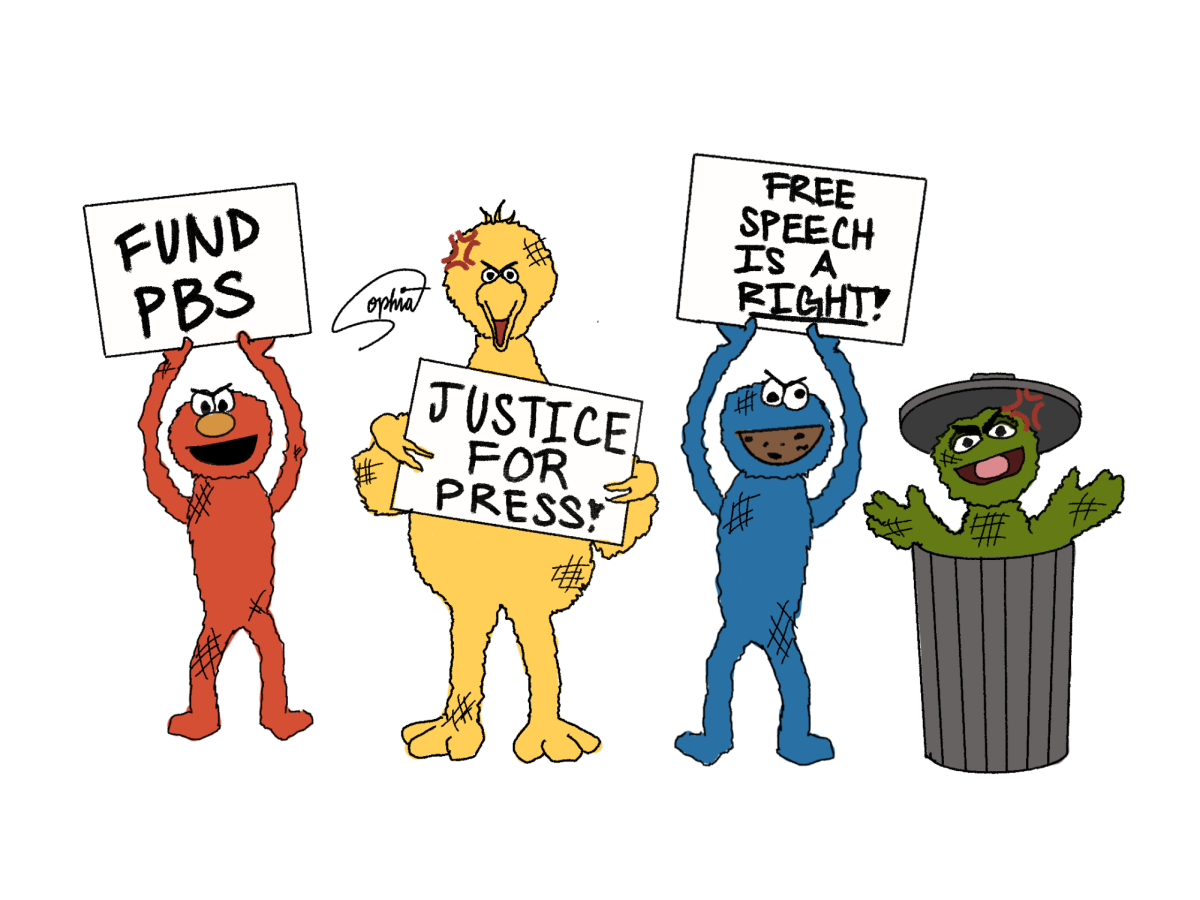
Due to Congress revoking more than $1.1 billion in federal funding, the Board of Directors of the Corporation of Public Broadcasting (CPB), the largest single source of funding for more than 1,500 public radio and television stations, voted to dissolve the organization after 58 years of service, Jan. 5. The abolishment of CPB may lead to substantial financial setbacks for numerous media stations.
CPB was established when Congress authorized the Public Broadcasting Act of 1967. This act encourages the development of public broadcasting by providing consistent funding. It also ensures that U.S. citizens have access to public telecommunications services.
For decades, CPB has been the backbone of funding for broadcast stations, including stations as big as Public Broadcasting Service (PBS) and National Public Radio (NPR). According to Current.org, 467 stations relied on federal funding for an average of 16% of their total revenue in 2023. Public television stations had the greatest reliance, making up 18%, while public radio stations had an average reliance of 14%. NPR and PBS relied on federal funding for an average of 13% and 18%, respectively.
However, since CPB is directly controlled by the government, changes in political ideologies have significantly impacted the stability of public broadcasting. The Trump Administration argued that stations funded by CPB have expressed liberal bias. According to a statement made by the White House on April 14, 2025, “NPR and PBS have ripped us off for too long, and have spread radical, woke propaganda disguised as ‘news.’”
Leaders of NPR and PBS rejected this allegation, and, according to NPR CEO Katherine Maher, “One of the advantages of public media is that we serve everyone, and it is a requirement and a mandate. It’s also a very important mission in polarized times.”
By eliminating grand sources of funding from these networks, public broadcasting stations will experience significant budget cuts. For instance, according to Calmatters, KEET-TV, one of PBS’s affiliate television stations, is losing $847,000, nearly half of its operating budget, due to the defunding of CPB. To continue operations, KEET-TV said that all of its funding will need to come from community support, since the station has no institutional backer such as a local college or school district.
Beyond this financial issue, the defunding of CPB threatens our freedom of speech. The First Amendment of the United States Constitution states that “Congress shall make no law…prohibiting the free exercise thereof; or abridging the freedom of speech, or of the press; or the right of the people peaceably to assemble.”
Cutting over one billion dollars in federal funding due to political disagreements with broadcasters may cause broadcasting stations to shut down completely. For example, WPSU, a broadcasting station providing over 24 countries with television and 13 with radio, has made the decision to stop services due to CPB’s lack of funding. By defunding one of the biggest donors of broadcasting stations, local voices are silenced, and may lose the ability to spread reliable news about what is truly happening in the world. This in itself restricts free speech. Public broadcasting was created to ensure all Americans, regardless of economic status or location, could have access to trustworthy journalism. Especially with a widespread amount of misinformation, the press is needed to educate and inform the people. Reliable information is a right, and should never be threatened.