

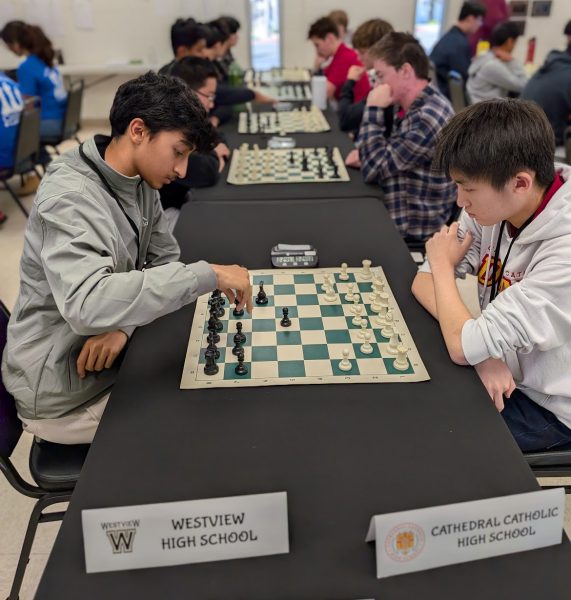
 Lucas Ding (9) sat across from his opponent, eyes fixed on the chess board as the clock ticked down at the 2026 Regional High School Teams Championship, Jan. 11. Instead of reacting to the move in front of him, Ding focused on what was coming next. He noticed his opponent setting up an attack, slowly moving his pieces for a strategic position. When the move finally came, Ding was ready. He spotted a small inaccuracy, as his opponent had removed his rook off an open file, which is a vertical column on the chess board containing no pawns. He took advantage of it and infiltrated his king side, eventually winning the first round of the championship.
Ding said that the key to success in any match lies in the ability to anticipate multiple moves into the future, both his own moves and his opponent’s moves. He won three out of the five rounds he played.
“If an opponent is threatening one of my pieces, I need to have a move ready to protect it,” Ding said. “Sometimes they make moves to prepare for something else, like opening up space for another piece or creating a new attack. You have to anticipate that before it happens, or you could get into trouble.”
Practicing with this mindset helped Westview Chess Club place third out of 15 schools at its most recent tournament hosted by the San Diego Chess Club.
The competition followed a five-versus-five format, with each player on the team facing an opponent from another school and every win, draw, or loss directly affecting the team’s overall score. Each match spanned a time of 25 seconds with a five second grace period. Teams were matched against one another based on their results each round, meaning cumulative wins led to matches against higher level teams as the day went on. Westview won four out the the 6 rounds in the championship.
Chess Club President Vedant Maheshwari (10) said the competition was fierce, especially when Westview faced strong teams.
“There are tough teams like CCA, and I just wanted everyone to be confident, no matter who was playing or who they were playing against,” Maheshwari said. “Our mindset was that if you had a tough matchup, you had to play with confidence and trust your ability. That’s kind of what propelled us.”
Maheshwari said preparing for the competition meant reviewing tactical skills individually with each player.
“Everyone in the club plays at a really high level,” Maheshwari said. “Personally, I tried to go around and talk to everyone to check in on their openings. Everyone supports each other in that kind of way because we want everyone to feel ready for the tournament. Everyone has a different type of thing they need to be prepared for, either tactically or strategically.”
Maheshwari said that the supportive team culture is something he has worked hard to build. A longtime chess player himself, he described the club as a space where anyone, from beginners to experienced players, can feel welcome and also improve their chess skills.
“Right now, we all play against each other and just learn that way,” Maheshwari said. “It’s just a fun community where everyone can enjoy it. Anyone at any level can play. Everyone in the club comes as often as they can, and not only are they playing every week, they’re also playing online a lot. So you improve over time, and I’ve definitely seen everyone improve as well.”
Improving their skills in chess contributes to their daily life as well. According to Ding, his focus on predicting different outcomes from his opponents’ moves has also proven useful in daily life.
“Being in Chess Club made me think more,” Ding said. “It made me think more about others’ decisions, and it also gave me better logic skills, which improved my math and other subjects at school. You have to think about predicting and also looking carefully [at] all the possibilities, which is important in many math problems.”
Maheshwari said the success of the team was due to the effort, experience and support its members contributed.
“Honestly, I’m really proud of everyone on the team,” Maheshwari said. “They put a lot of effort in. Everyone was playing regularly and improving before the tournament. Lucas Ding started coming into chess and made a massive improvement, and our seniors are the heart of the team. With everyone’s experience, it really made this tournament possible for us to do this well.”