
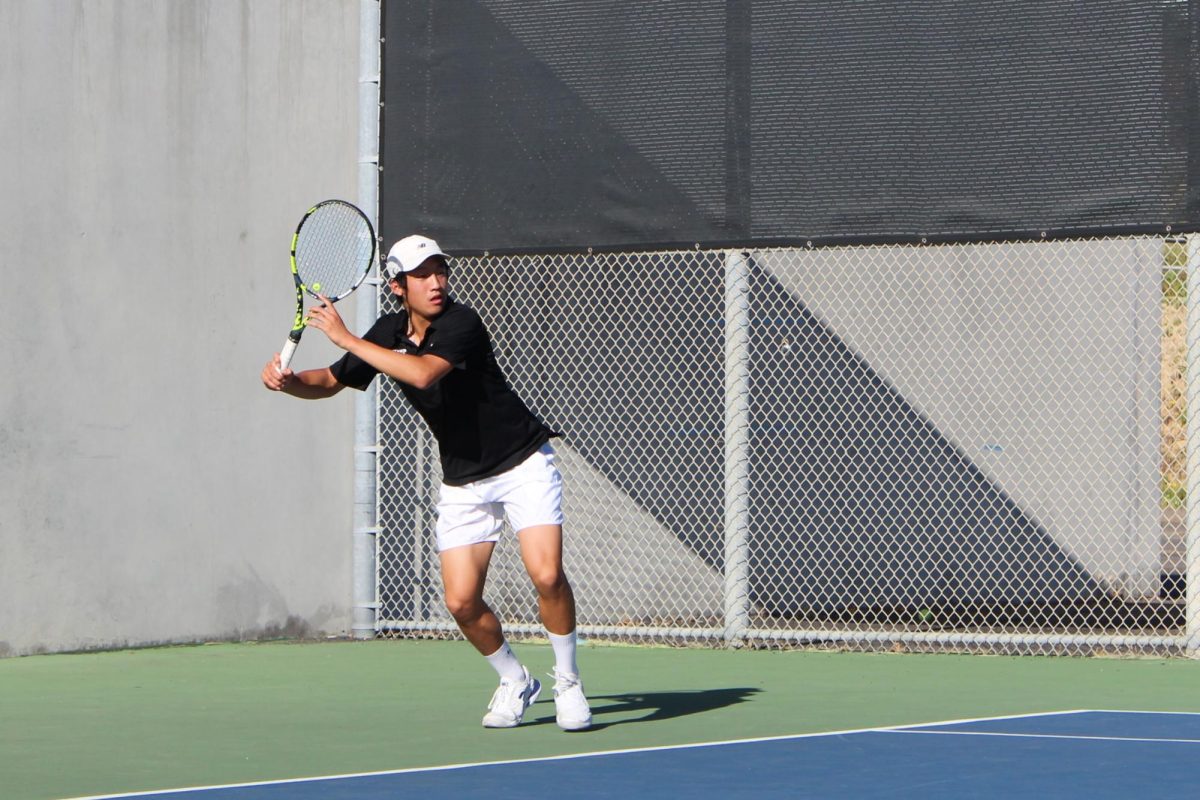
From analyzing past matches to putting in countless hours, Ian Yang (9) does whatever he can to improve on the tennis court. With a Universal Tennis Rating (UTR) of 9.30, Yang primarily plays singles and occasionally plays doubles.
“I strive to keep on improving and have better competition, to compete better and against better [players],” he said.
Yang said that in his matches, he studies the techniques his opponents use and utilizes that knowledge to try to counter them. He said that learning over the course of the match is key to getting better.
“When you’re in a match, it’s just you and no one can really coach you,” Yang said. “I always want to first isolate each one of [my opponent’s] skills and try not to mix [skills] up together. I isolate how they like their forehand so if it’s low, if it’s higher, if it’s slower, if it’s faster. I go through those step by step. What I can do is when I hit shots, change it up more. Change up the speed, the rhythm, instead of giving them the same thing, the same pace, same shot.”
In one of Yang’s most recent competitions, he was placed as the third seed and faced off against the second seed in the semi-finals. Yang said that even though he lost the first set, he learned and adapted, winning the second set.
“Matches, especially when you lose, are probably the biggest way to see your improvements,” Yang said. “If you can record yourself [while you play], when you lose, you can see what your opponents did to be able to win.”
Yang said he uses his free time to practice and hone his skills.
“I train every day after school, and I have OCIS-PE (Off Campus Independent Study for Physical Education),” he said. “I can use that extra time to practice with my parents, my coach, or with friends.” He also works with his coach twice a week.
Considering he started tennis only a few years ago, Yang has had roughly six years to raise his UTR and improve his skills.
“I started playing tennis the summer when I was 10,” Yang said. “I first started when I was in China for summer break and with COVID, it was hard to find more contact sports, because this was right after we were actually able to go out more instead of being so quarantined. It was still really hard to play contact sports so I decided to take some lessons in China for tennis.”
Yang said that as matches extend, he focuses on maintaining his concentration and keeping calm. Additionally, he said adapting his strategy is crucial in longer games.
“When you’re going through [the match], you want to have a really strong mindset,” Yang said. “You don’t want to get angry all of a sudden. You want to concentrate more, focusing on what shots they’re hitting to you and if it’s working or not. If I have a bad forehand that day, I want to notice the patterns that [my opponent is] doing. So when you’re losing, you always want to change. You want to constantly change and not just play as one style.”
Yang said a big goal for him is to compete in 16-and-under national tournaments, since he was able to participate in national tournaments for both 12U and 14U groups.
Yang said that each match offers an opportunity to learn and improve from those experiences.
“What really changes these matches is how you can change your mindset and your mentality,” Yang said. “The turning point is being able to push through the hard parts, get over that and not give up, and still find their weakness.”