
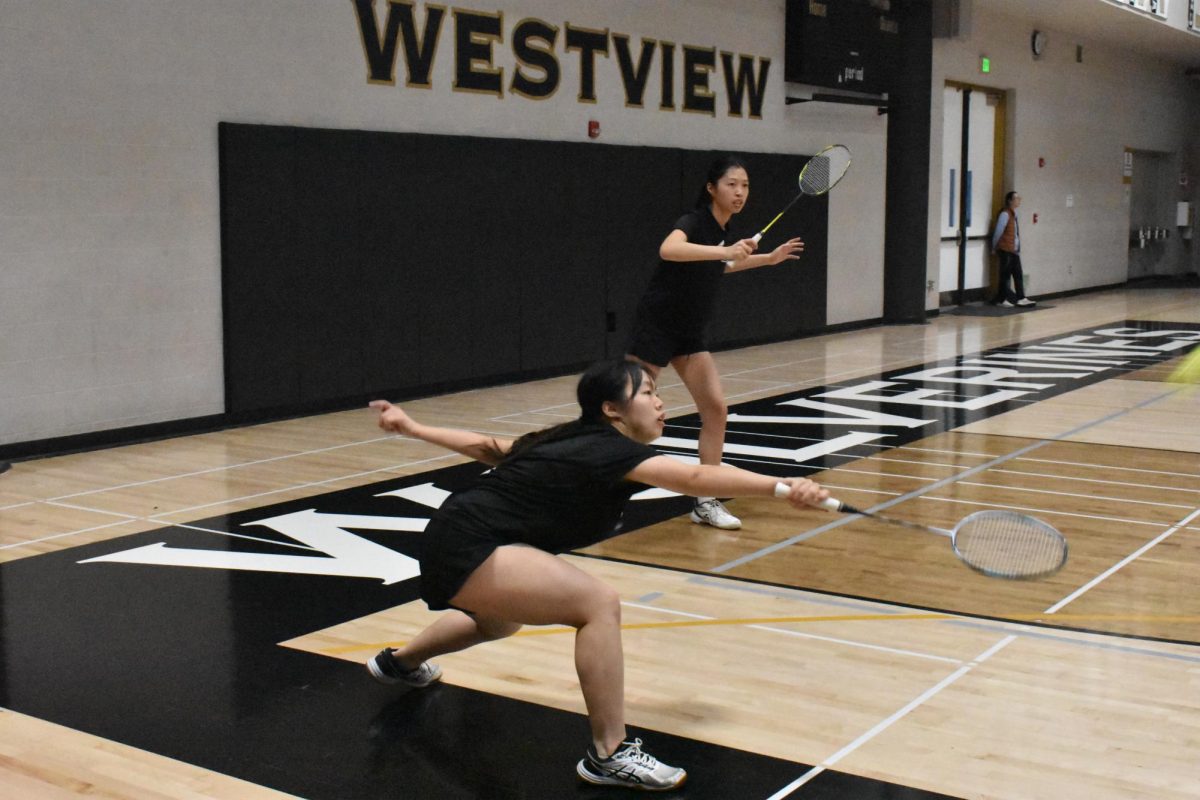
In the second set of her badminton match against Rancho Bernardo, Alice Lau (10) and her doubles partner, Lydia Tsai (11), covered the court in the standard front-back position ready to receive the birdie, March 23. As the birdie soared over the net, Lau wound the racket behind her head, preparing to smash. Tsai ducked down to maximize the space for Lau to deliver the strike. Lau’s blow ended the match with a win against the Broncos, 21-13.
The Wolverines won two of three games in all three doubles categories: girls doubles, boys doubles, and mixed doubles. Badminton also won three of four games in both the girls singles and the boys singles to beat the Broncos 12-5.
This game was Lau and Tsai’s second time competing as doubles partners. According to Lau, they focused on rotating positions on the court to maximize both of their strengths.
“We switch from the two main positions [front and back] and rotate to cover the whole court,” she said. “However, anytime we lift the birdie high into the air, we go into a side-by-side position to cover the court if the opponents smash. If we’re the ones attacking, smashing, or killing, we’re in the front and back positions. This game, we tried to focus more on me in the back and [Tsai] in the front. At the back, you have to be more powerful because you have to clear across the entire court. In the front, you have to have faster reflexes because the birdie comes at you faster, and you’re closer to the net.”
Lau said at first, they served too high to the opponents, and every shot was killed. After understanding the Broncos’ attack style, the duo focused on serving tighter shots.
“We tried to serve as close to the net as possible so they didn’t have the opportunity to come forward and attack,” Lau said. “They were pretty good at front net drops, so we tried to lift to the back more, where they missed a lot. They also had a harder time defending our smashes.”
Mixed doubles player Kate Liang (12) said she and her partner Brandon Tran (12) also tried to focus on finding their opponents’ weaknesses. One of Liang’s opponents was a nationally ranked player, she said they had to focus on hitting to places he couldn’t cover to score.
“The second you lift to him in the back, it’s basically game over,” Liang said. “His smashes seemed impossible to defend, so we tried aiming at his partner. We also dropped it right in front of the net where he couldn’t reach.”
Liang and Tran lost their first set 21-8 and their second set, 21-16. Liang said they were able to adapt to their opponents’ playing style by the second set, doubling their points from the previous match.
“On the first set, we were driving a lot, and [our opponent] could outdrive us, so instead of driving all the time, we placed ourselves more strategically,” Liang said. “One play, [Tran] was trying to smash in the back while I was defending in the front, that round we made their best player run back and forth. We ended up getting that point.”
Singles player Hannah Dang (12) said she figured out her opponents’ playing style by testing how she responded to her pushes.
“The general rule of thumb for singles is to always push your opponent back,” Dang said. “Initially, I was just doing that. Then I always see how my opponent reacts to being pushed back. Sometimes they might drop the shot right in front of the net, other times they’ll push it back or just smash it down. I also tried to smash at the corners a lot because, as a singles player, you can only reach so far.”
According to Dang, the typical single’s strategy of aiming towards the back was effective on her opponent. She won both her sets, 21-13.
“I kept clearing to the back, and it worked,” Dang said. “When she hit towards the front, I was able to smash down and get a point.”
Dang said as the match progressed, her opponent started targeting her backhand. She also lost points for being too ambitious and constantly smashing out.
“I tend to hit a lot of my shots out,” Dang said. “If [my opponent] was at the front, I would try to clear and hit to the back, but then I’d hit it out. My backhand also isn’t as good as my forehand, so it got targeted quite a bit. I tried to get to the middle faster so I wouldn’t have to reach so far to do a backhand, and instead I could hit from a more comfortable position.”
Despite RB’s team having two nationally ranked players, the Wolverines still came out on top.
“There are a couple of really good Rancho Bernardo players,” Dang said. “We struggled against those people, but overall, our team did really well and won.”