
The Career Technical Education (CTE) building will open today with a ribbon cutting ceremony, unveiling a completely new space for Westview’s engineering courses such as Introduction to Engineering Design, Honors Principles of Engineering, Computer Integrated Manufacturing, Digital Electronics, and the robotics program. The ribbon-cutting ceremony will feature a special mechanical component: a ribbon-cutting robot.
Science teacher Dawn Hester had proposed the idea of building a ribbon-cutting robot to Digital Electronics and robotics students Rayyan Hussain (11) and Haresh Udayakumar (11). Alongside a group of peers, they designed the robot in Digital Electronics and built it over winter break.
“We worked in a group of people from Biomechanics and Digital Electronics,” Udayakumar said. “It was a group of around seven people, and we helped design and program the robot. We would work on it in Digital Electronics but mostly outside of class. In total, we worked on building it for around 10 hours, mainly during break.”
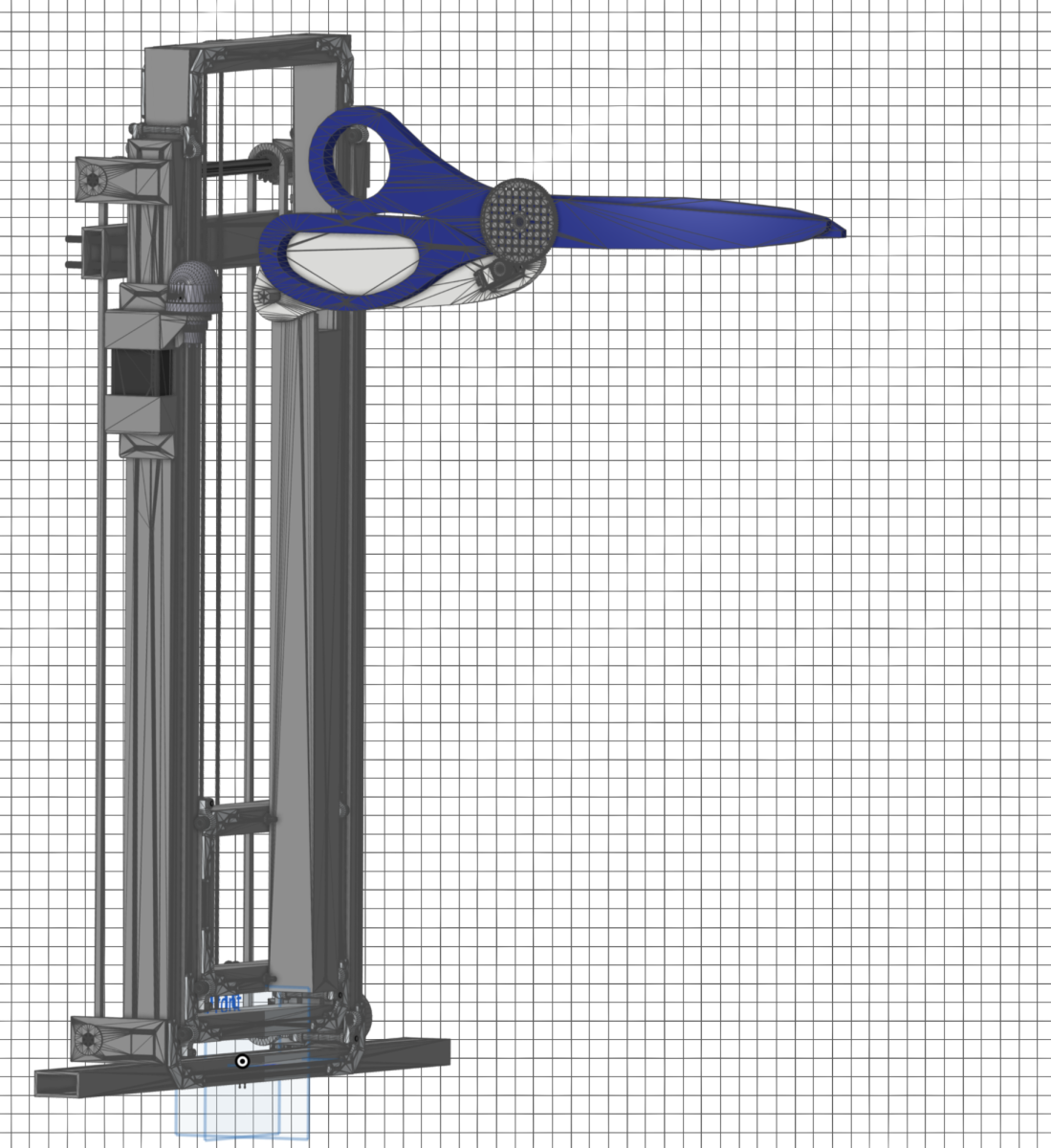
Before designing, creating, and assembling the robot, Hussain and Udayakumar brainstormed concepts. The final design was a result of multiple ideas which were then developed into a computer model on Fusion 360, a computer-aided design and Drafting (CAD) software.
“Every day during fourth period, we would go outside and discuss ideas,” Hussain said. “We would get into groups and come up with ideas and then present them to everyone else. In the end, the design was a combination of the group’s ideas.”
At first, the group faced issues as they had to create a robot attachment that was actually sharp enough and able to cut the ribbon but also met safety regulations. They landed on utilizing a scissor arm extension.
“We were a bit unsure about the designs we came with at first,” Udayakumar said. “One of the first designs we came up with might have been a little bit too dangerous, so one of the main challenges was figuring out something that could cut the ribbon, but also looks professional and is actually safe.”
After finalizing their idea, Hussain and Udayakumar started sourcing materials.
“After we figured out that we were going to use scissors and mount the arm onto a polycarbonate plate, we bought massive scissors on Amazon,” Hussain said. “Using that, we figured out all the dimensions and made a CAD model of it based on the scissors’ shape. We made a shape that fits onto our existing robot so [the arm] would pivot up and down.”
They learned how to use a Computer Numerical Control (CNC) machine to cut their polycarbonate into exact pieces. Through the CAD software, a G-code, the most commonly used CNC and 3D printing programming language, was developed and sent to the CNC machine, allowing them to accurately cut pieces that matched their CAD model.
“The main piece is a 38-inch piece of polycarbonate,” Hussain said. “You enter what’s called a G-code and then the machine does all the cutting for it. In the CAD software we use, Fusion 360, there’s a manufacture mode. In there, you can write the G-click for the CNC and then when you send that to the CNC, it’ll do whatever instructions you put in. It’s a three-axis CNC, so it has a drill bit on it which will trace the shape and cut it out.”
Hussain said that the mechanism was based on a servomotor which they had used in the First Tech Challenge (FTC). It was coded through p-modulation, a series of controlled pulse signals corresponding to the degree of the motor mechanism.
“And then we used a servo, which was commonly used in FTC,” Hussain said. “From the programming side of things, I learned how to control a servo. Basically, servos use something called p-modulation. You give it a pulse that lasts for a certain amount of time and depending on how long that pulse is, it’ll turn the servo a certain amount of degrees. You have to figure out what pulse time corresponds to what angles through testing it. Then in the code, we basically tell it to open to this specific angle.”
Hussain, Udayakumar, and their group had a short window of time to actually put the robot together, which forced them to simplify their original plans. They came into school during break to complete their build, Jan. 2.
“We had to make [the robot] pretty quickly because we only had a day to assemble it,” Udayakumar said. “It was difficult to make the most simple design. After we made that main piece, we couldn’t really make any modifications to it. We had to mount an additional metal piece on the plastic and we didn’t really have sufficient tools to do that, so we had to use a hand tool.”
Hussain said that designing and building the robotic ribbon-cutting mechanism in such a short period of time helped him prepare mentally for the upcoming robotics competition season and reveal what he and his robotics teammates would need to work on.
“It taught us to make a design faster,” Hussain said. “Last year in robotics we were designing at a slower pace, so this taught us to be faster with fabrication and design. It’s like the workflow of robotics but on a medium scale, but instead of having to create an entire robot, it was more focused on one mechanism. Since we’re heading into competition season now, it kind of gives us a head start to knowing how we can be more efficient in coming up with solutions and then actually executing them”