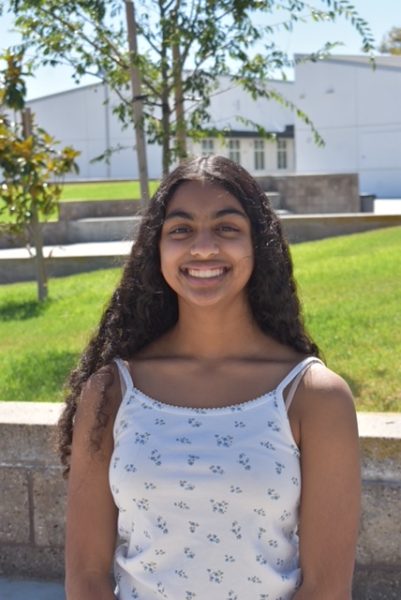

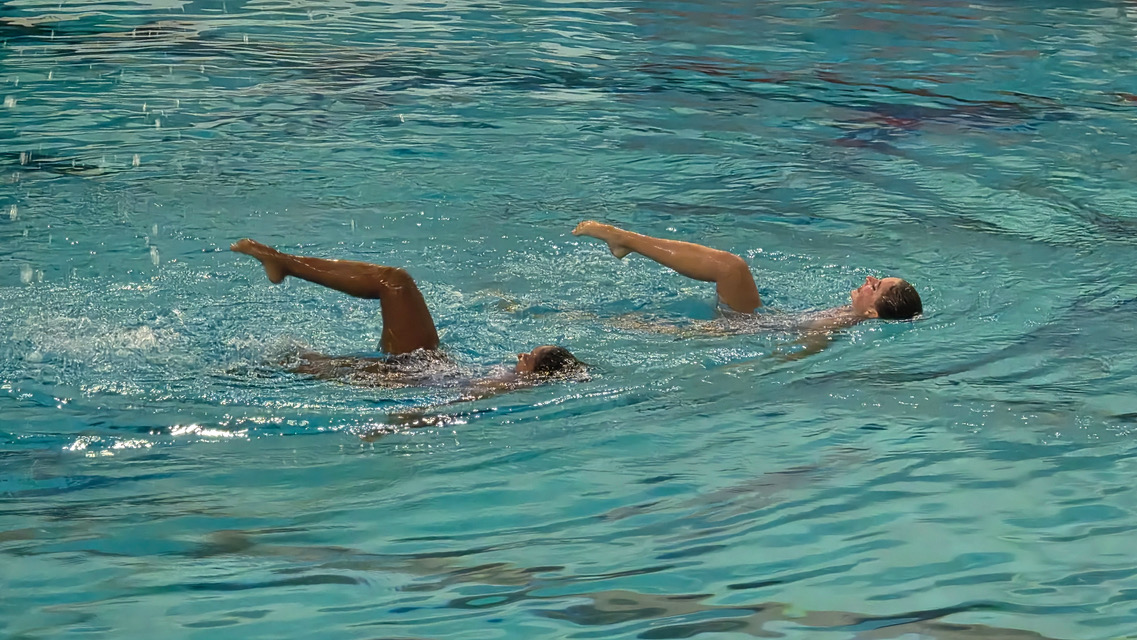
Parise Mason (10) positioned herself in the pool alongside her duet partner for their synchronized swimming routine. The moment the theme music from “White Lotus” started playing, they kicked their legs up high out of the water perfectly in line with the music, sending splashes of water onto the pool deck. When the routine came to an end, the two swimmers climbed out of the pool, the applause from the audience echoing in their ears. Their hours and days of intense practice had culminated in this final moment at the Junior Nationals for Artistic Swimming, April 10.
Mason and her partner were the only two swimmers from their team, the San Dieguitos Sea Dragons, who qualified for the national competition in Buffalo, New York. They competed in the Junior Women Duet Technical Event and were ranked 21st nationally. Her routine consisted of five required elements of basic skills and a hybrid element where the swimmers’ legs are out of the water.
“I enjoyed this type of routine because it is generally easier and we get more breathing time,” Mason said. “It’s a good way to show off different skills instead of repeating the highest difficulty skills. We had a lot of fun performing this routine.”
Mason and her duet partner performed the same routine at West Zones Artistic Swimming Championships in Sacramento last month, which qualified them to compete in the national competition. She said that since this was an unexpected opportunity for her team, she and her partner focused on enjoying their performance rather than to achieve perfection.
“We were very excited because we weren’t expecting to qualify,” she said. “When we did [qualify], our coach made sure to let us know that once we get to the competition, there’s nothing else we have to [worry] for. We should just have fun and perform at our best. Our team has the mindset that once we’re there, there’s nothing to lose. If you do bad, you do bad. You just have to have fun because you don’t really ever get to just go to nationals all the time. It’s [nerve-wracking] when you’re standing up there waiting to do your routine, but you just have to go for it.”
Thirty duos were selected nationwide to compete in the event that Mason and her partner were in. Since this was one of the largest competitions they have been a part of, Mason initially did not feel satisfied with the performance.
“I actually didn’t feel great right after my performance,” she said. “I thought I had done poorly, but my duet partner thought we did amazing. I was skeptical, but my coach also told me that it was an incredible swim. So I watched the video of it, and it turns out it was probably the best one I’ve done. I felt great about it afterwards.”
To prepare for this competition, the swimmers went through intense training and practices every week.
“We practice [around] 15 hours a week,” Mason said. “Three days a week in the water, and one day with a private trainer for endurance and cardio. Usually, practices are about three to five hours. It got ramped up a bit for the competition, but it’s usually like this because we’re a competitive team. We also got to practice there, because we didn’t immediately perform. We had the next day to [prepare] and practice our routine. All this really prepared us for the performance.”
In the four years Mason has been doing synchronized swimming, she has been able to compete and place nationally. All throughout her journey to get to this point, she said her teammates motivated her to keep pushing forward, through rough days at practices, bad performances, and physical struggles that impacted her mentally.
“I have two teammates [who] I’m very close with, and they’re one of the main reasons why I keep coming back to this,” Mason said. “If I’ve had a horrible day at school, I’ll walk into practice and my teammate would just run up and give me a hug without me having to say anything. They’ll do anything a sister would do. At nationals, it was only me and my duet partner. I remember cheering so loud for her solo event to support her. No one else from our team came up with us, so it was just us. We helped each other out a lot during this time.”
With the support she has received from her friends, she pushed through the challenges she faced this season.
“Now that the big competitions are over, the fear and anxiety of not being good enough started to go away,” Mason said. “Sometimes it’s really hard to, but you have to have that discipline and push through when things are hard or you just want to give up. The hardest part is having to keep coming back. The coaches will constantly say that if you don’t want to be here, you don’t have to be here. But you feel the obligation for your team. It comes down to your choice of wanting to grow into that disciplined person and show up for the people that you made the commitments to.”