
A hum of a single melody echoed across James Truax Performing Arts Center, leading the rest of the ensemble into harmony. Following the lead of conductor Mitchell Way, the band gradually shaped its notes into tension-filled chord progressions, with fast rhythms pushing the tempo forward. At last, a blaring strike of the cymbals marked the powerful end to the Wind Ensemble’s performance at the El Camino Festival, March 7.
Orchestra took the stage on March 6, and the Concert Band, Symphonic Band, and Wind Ensemble played on March 7. The festival gathered schools around North County to provide public performance opportunities and constructive criticism from adjudicator panels.
David Jang (12), the principal oboist and English horn player in Wind Ensemble, said that he enjoyed the performance.
“[The performance] couldn’t have been better,” Jang said. “Some parts we did really well and I think it was a very fulfilling performance. It was two pieces that we really loved, and that’s rare because not everyone always loves the repertoire unanimously, so it was a fun experience for us.”
Wind Ensemble played two pieces at the festival: “The 7th Night of July,” composed by Itaru Sakai, and “El Camino Real,” composed by Alfred Reed. In specific parts of these pieces, the oboe and the English horn are meant to play consecutively, forcing Jang to switch back and forth between two instruments during the piece.
“Oboe and English horn are reed instruments, and they are made out of wood or cane, and it’s very variable to the conditions,” Jang said. “You have to keep in mind those variances, but luckily for these pieces, there weren’t too many exposed parts where I’m switching, so it wasn’t too painful. The English horn also takes a lot more air. It [sounds] a lot more [rich] than an oboe, which feels very thin and direct. So having to learn how to deal with that was fun.”
Vice president and French horn section leader Luke Millay (12) said the band put a lot of time and effort into “El Camino Real,” giving the opportunity for band members to play with confidence.
“‘El Camino Real’ is a piece that I’ve known for a really long time and the fact that we get to play it in my last year of band is so great,” Millay said. “We’ve been preparing these pieces since late last year. We’ve had plenty of time and a lot of great rehearsals. I think we were well prepared.”
The Wind Ensemble received a Unanimous Superior rating, which is the highest possible rating at the festival. Millay said that the results reflected his personal experience of the performance.
“The quality of the sound that we have, I really don’t hear it from that many other bands,” Millay said. “And the fact that I get to be there in the center of it is awesome. These pieces in particular have some really emotional and climactic moments. Every single time we play them, I get these shivers. It feels like such a privilege that I get to be part of this ensemble and that I feel strong emotions every single day. And then the fact that we get to play these pieces in a concert hall where I can feel everything to an even greater extent is really cool. I can just get into it and everybody else is feeling the same way as me.”
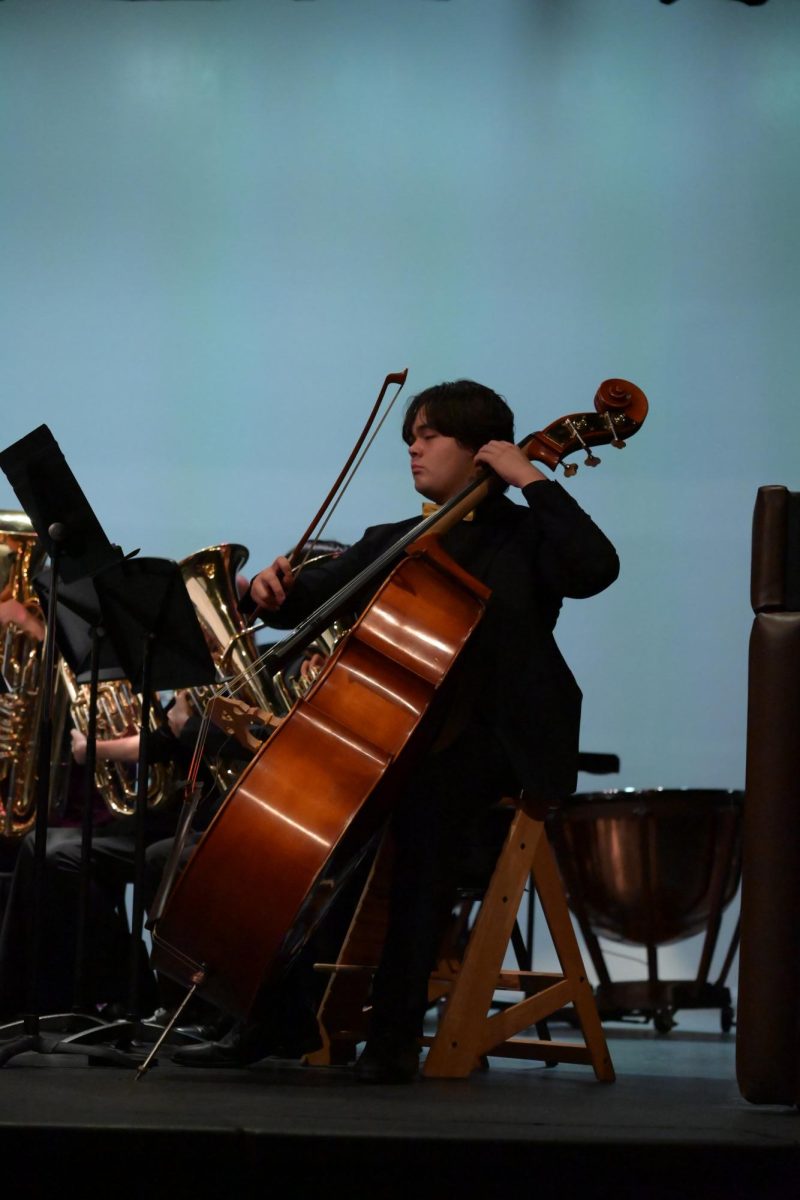
A day before the band ensembles performed, Orchestra presented “Orion and the Scorpion,” by Soon Hee Newbold, and “Rikudim,” by Jan Van der Roost. Orchestra president and bass section leader Liam Doran (12) said that “Rikudim” was a difficult piece for them.
“‘Rikudim is a really modern piece,” Doran said. “It’s four movements with different moods. It’s much more challenging, [almost] like professional literature. A lot of extended techniques are used, especially in the upper strings with harmonics and bowing techniques. It’s a fun piece to play.”
Doran said “Rikudim” was his favorite piece to play, specifically the fourth movement, because of its creative technique.
“We get a tin foil and weave it between the strings,” Doran said. “It almost creates a percussive effect, like a snare drum, a really loose one. When you play, you get not only the ring from the instrument’s tone, but also this rattling sound. This piece was originally composed for a wind ensemble. There, you have the whole palette of textures to use with all the winds and percussion. But with strings, you really have to get creative to get those extra textures, hence the reason for so many extended techniques.”
Doran said the challenging techniques make the pieces more fun to perform. He likes going to festivals because of the feedback and appreciation of those techniques.
“We have our concerts and GOLD shows and stuff, but at those, the parents are always going to clap for you,” Doran said. “But at the festival, you’re playing for the adjudicators and professional musicians. It’s not all about scoring well and getting a good rating, but more about having the validation of those musicians. I think that is a really rewarding part of the festival.”
Additionally, being a part of GOLD involves another layer of experience. Jang said he learned about subjects beyond music during his time in GOLD.
“[Playing] music is a lot more interdisciplinary than I thought,” Jang said. “For example, it’s a bit of physics because Mr. Way talks a lot about the acoustic. The [hall] is a very different environment than our rehearsal room. Also, it’s a little bit of history and culture. ‘El Camino Real’ is a blend between Mexican and Spanish [styles], and ‘The 7th Night of July’ is a Japanese piece. Getting to learn and blend all these different ideas feels very fulfilling to me. I didn’t expect to get so much out of being in a band.”
Jang said that the experience of being in band and the lessons he learned from it were priceless in many ways.
“A lot of the stuff that I learned from band is not music-related,” Jang said. “It’s taught me a lot of life lessons. There wasn’t really a profound [moment] where I had an epiphany on this exact day—none of that. They were all small lessons that I picked up from my mentors and my friends. I think those were one of the most valuable things I’ve had in high school. I’ve learned how to deal with nerves, how to stay calm and disciplined, or even how to talk to adults. It’s taught me more things than I thought I would get out of just marching on a football field or sitting on a chair and playing music on paper.”