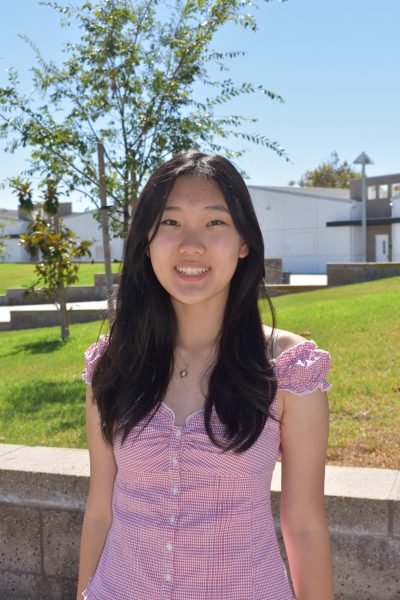

The presentation room buzzed with life at the San Diego Convention Center as students and biomedical professionals navigated around vibrant posters displaying research conducted by high school students, Oct. 11. There, at the Biomedical Engineering Society (BMES) 2025 Annual Meeting, four Westview students showcased their science research. Held annually, the event gathers more than 5,000 attendees to explore innovations in the biomedical engineering field. The event allocated a block for a high school poster expo, where students from around the nation were invited to present summaries of research they had conducted in the field. From Westview, Brighton Li (12), Derek Lam (12), David He (12), and Jaelyn Liang (11) presented their findings at the event.
For his research project, Li worked with a group at UC Irvine’s COSMOS, a four-week STEM summer program. There, he researched the effect of different antioxidants on the metabolic action of cancer cells. By studying antioxidants in relation to cancer cells, Li said his group hoped to make their findings applicable to the general public.
“Some antioxidants are found in everyday foods that you eat,” Li said. “[In our research], we were trying to test superfoods to find if their antioxidants would impact cancer development. Our first idea was that eating more of a certain [antioxidant-rich] food can be a preventative measure for cancer, but our results showed that some lipids would be increased, and others [wouldn’t]. We needed to research more on specific lipid reactions instead of just a general reaction. If I have the opportunity, I would like to keep on researching it.”
Li said it was fascinating to see what other students had conducted research on.
“It was interesting because much of the research there was really different from what I had,” Li said. “There was a wide variety [of studies]. For example, I saw a study about virtual reality augmentation, which is very cool.”
Lam worked with a group at UCSD OPALS, another four-week summer program. He acted as the lead investigator for his group and worked to create an automated, computerized method for tracking antibiotic-resistant genes.
“Antibiotic-resistant genes (ARGs) are a big problem,” Lam said. “One way they spread in the environment is through wastewater, so our project looks at these pipelines that help detect ARGs using a lysimeter system. The problem is the process is very slow and tedious; it takes hours to run. So my project was about automating the process to make it faster and then creating visualization for it to make it easier to interpret.”
Lam said he hopes his research can help people be conscious of what they consume.
“It would help us know where food is grown, so we can be able to track it better,” Lam said. “We’ll be able to learn the patterns of how these antibiotic-resistant genes transfer, which helps us prevent [them] from harming us in the future.”
Focusing more on molecular science, He and Liang worked as a pair for their own research project, where they worked to equip an AI model to accurately bind proteins, which ensures that incorrect protein confirmation doesn’t occur. Liang said she is proud of the progress they were able to make on the study and is optimistic about its potential application in the public health field.
“Compared to previous models, we had much fewer clashes between the binding of proteins,” Liang said. “This is really important for drug discoveries. For example, if you want to make peptide vaccines, it’s important that they bind to the correct sites.”
The project required concentrated work at the molecular level. He said he has a personal interest in molecular biology.
“I’m just really fascinated with how life operates,” He said. “Life is a really complex system that is formed by a bunch of very simple parts. You have so many simple building blocks, and they somehow form a dynamic stability, a life system.”
The BMES Annual Meeting was not only a research showcase. Liang said the event planners also prepared a college fair on the same day, enabling participating high school students to explore colleges that specialize in research.
“I really liked the college fair,” Liang said. “Walking around the [college] fair was fun, and it was interesting learning about all the opportunities the colleges have to offer.”
The BMES participants were supported by the program’s emphasis on equipping the youth with resources. Lam said he was inspired by the attention BMES gave to voices in youth science.
“The goal of science is to progress and bring in diverse views,” Lam said. “With this high-school expo, you’re not only allowing more voices and opinions on various topics, but you also get a broader view of what’s going on in research. By having these types of opportunities, it’s nice for the younger generation to gain more experience and be inspired to continue to pursue science in the future.”