

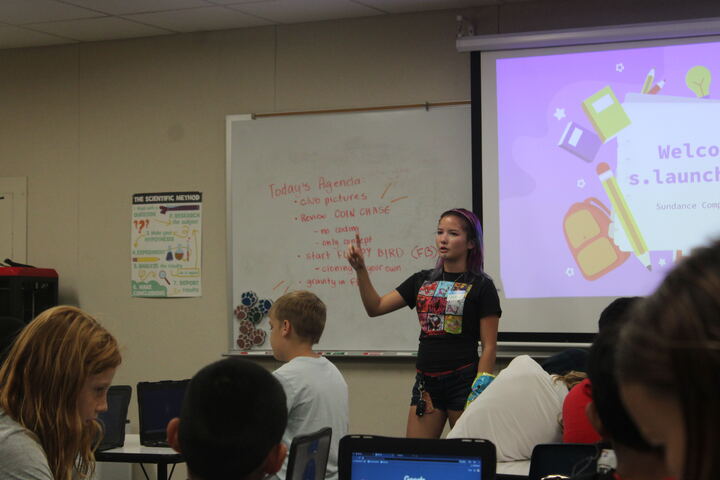
When the computer science program that sparked Jade Peters’s (12) passion for programming shut down in 202 due to the Covid-19 pandemic, she decided to revive the program for new fourth and fifth graders under the name ‘S.launchgame()’.
“When I realized that [the program] was gone, I wanted to bring that opportunity to the new students,” Peters said. “I really love computer science, it’s what I [will study]. I think the coding class really helped me understand science and become interested in academics.”
Every Wednesday, Peters joins 6 Westview student volunteers from ‘S.launchgame()’, and teaches Scratch to students at Sundance Elementary School.
“We [create] projects over the course of two weeks, and then after we’re done with that project, we have a quiz for them, and we teach design principles that are applicable outside of computer science for engineering, math, and basic logic,” Peters said.
Utilizing lessons she designed to prioritize student interaction, thoughtfulness, and critical thinking, she said that her teaching style revolves around what the students want, not what she would like to teach.
Her lesson plan is divided into 12 weeks, each of which has easy-to-digest coding lessons along with the creation of video games for the students. On the first day of the program, she led an activity to help students understand the intricacies of coding, while getting to know the student volunteers.
“The first day we did a PB and J coding activity, where the students write down instructions on how to make a PB and J, and then the volunteer reads the instructions and basically messes up the sandwich as much as they can,” Peters said. “It’s supposed to teach the students that they have to be really specific in their instructions, [and] they have to tell the computer to do everything they want. The computer doesn’t know exactly what to do unless you give it specific instructions. And it’s a fun opening, [because] they’re getting to know the volunteers and also becoming more comfortable with the people at their table.”
Peters’s lesson plan reflects why she loves to create games. Her lifelong interest in coding has taught her to think mindfully and carefully, while still preserving the element of fun that coding has always brought her.
“I really like doing computer science puzzles, and making games in general, it’s [been] the main focus of my life,” Peters said. “Coding has helped me notice smaller errors that wouldn’t be issues in an ideal world, but are issues because we’re not in an idealized world. [At S.launch()], we really emphasize different ways to make our game fun.”
Through teaching, Peters said she realized the quick smarts and creativity of her younger students, as students even corrected her on mistakes.
“A lot of the time we underestimate these little kids because they seem so young and so tiny, but they’re really smart and intelligent.” Peters said. “They have interesting ideas. Sometimes they’ll find bugs in my code.”
Peters said that coding and computer science can help build skills outside of the classroom as well, helping students understand new perspectives, mature, and think critically. She recalls a specific moment when she saw a distracted student grow.
“They definitely see the different perspectives [after coding] a game.” Peters said. “After they leave, they seem to understand others’ perspectives more. We had a student who was [distracted] during the first meetings. It was hard to get through to him because he felt confident in his coding abilities. We implemented a reward system for participating, [gifting] treats when [students] answered questions correctly. He started paying attention, and if he answered incorrectly, we could address issues with his [coding]. At the end of the session, he and a partner made a really cool game involving the topics we’d covered early.”