
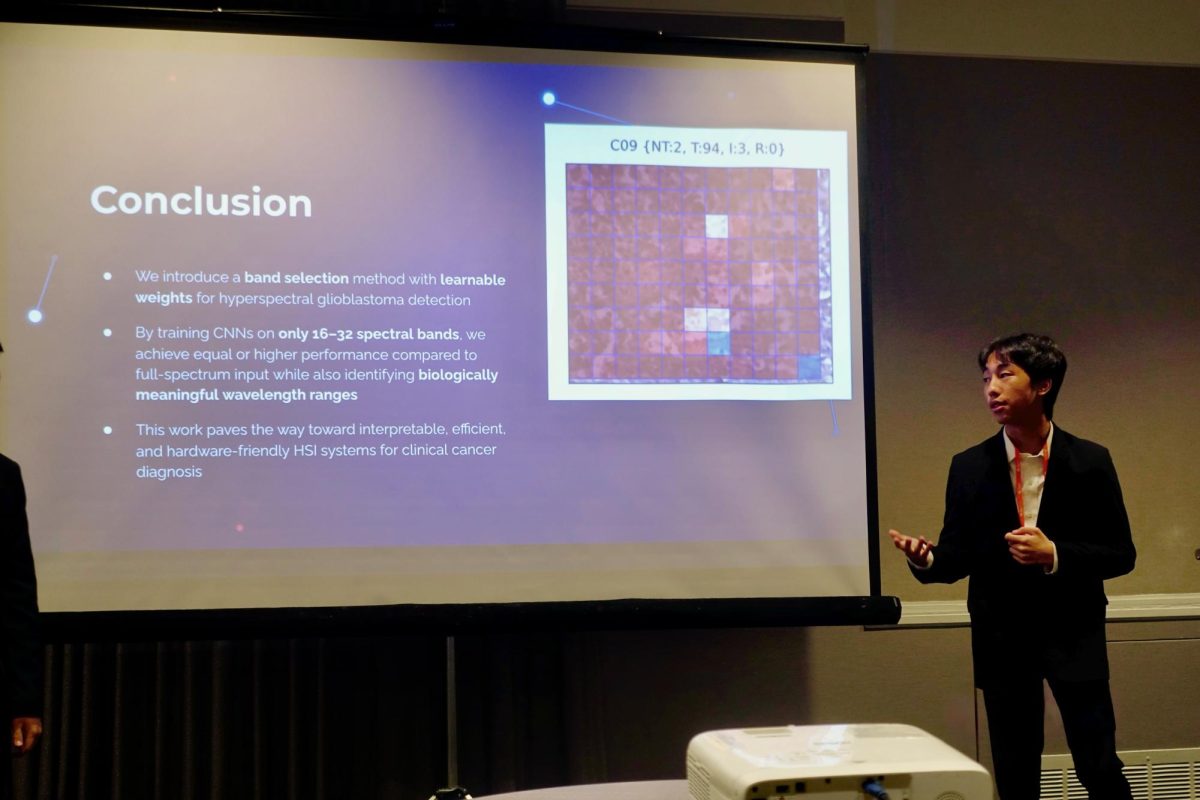
Albert Li (12) presented his project at the International Conference of Data Mining in Washington DC, Nov. 12-15. Manned with a poster and presentation, he explained his discoveries in distinguishing cells affected by the brain cancer glioblastoma from healthy cells through hyperspectral imaging—a method where the wavelengths of reflections of light are used to tell the makeup of cells—and his use of data mining to assess the huge amount of information.
Li said he has been working on this project since November 2024 with Professor Fei Xia from the University of California, Irvine. After months of research and experimentation, they wrote a paper and submitted their work to the International Conference of Data Mining for review, where it was accepted on Oct. 1. According to Li, most papers in the computer science category are published not through journals, but through conferences, where they are presented. There, he said that he was able to present his project effectively to the conference.
“I felt like they understood it pretty well, because we had fine tuned [the project], so we knew what we were talking about,” Li said. “[Before that, we had] our poster session. We set up our posters and talked to the people around us and to whoever was interested, we told them about our poster and project. It was still a good experience, and I really enjoyed it.”
Months earlier, for their research, Li said that he and Wu had learned how to perform hyperspectral imaging.
“This type of imaging shines different wavelengths of light and measures their reflections,” he said. “Different chemical compositions will have different reflections, so the data that we had was 826 different wavelengths of light. It was unprocessable by humans, because there was just so much data.”
Li had to sort through the wavelengths, or bands, to determine the 16 most significant ones to use.
“We cut it down to a few specific bands that were the most significant wavelengths of light,” Li said. “We went with a simple method that worked best, which was to take the average of three bands, so the number of bands was cut by three. Then, we divided each image into patches that were filtered further to get rid of any that didn’t have cells in them.”
With fewer bands, Li said the data could be used more efficiently and easily. From there, a machine learning model was used to differentiate healthy cells from cancerous ones.
“Wavelengths of light reflect differently off different composition materials,” he said. “A tumor cell would have a different reflection, with some values higher and some lower, than the normal cell. That’s what we train the model to identify the difference in. It [learns] the difference between the reflections for a tumor versus non-tumor, and then based off that, if the model sees any other data in a similar arrangement in the future, it’ll know, ‘This one looks more like a tumor than a non-tumor, so this region is probably a tumor.’”
Li said this could be used in hospitals to assist in brain surgeries.
“There are MRIs, EEGs, all those fancy machines to find electric signal responses from your brain,” Li said. “But theoretically, [the hyperspectral imaging] is less invasive. Mid-surgery, you can’t exactly beam light through a skull. You would already have the brain open in front of you, so you can have a small camera on the side that will take five seconds to identify a region, making it easier to identify which regions are cancerous or which regions are not cancerous. Hyperspectral cameras are not as expensive as MRI machines, which are millions of dollars, compared to a $50,000 camera, so these would be very helpful in surgery, hopefully.”
Li said he had been drawn to this subject because the two fields that most interested him were neuroscience and machine learning.
“My hope is to be able to work with machine learning a lot in the future and learn how the human brain works and apply that to machine learning,” he said. “[This project] was really fun because I got to actually build my own machine learning model for the first time. Previously, the machine learning models I used were pre-trained, and I would just specifically tune them for my purposes, but this time, it was from scratch. It was really rewarding. Being able to make a machine learning model makes me feel like I did something real, and that’s fun for me. Maybe it’ll have future applications, maybe it won’t, but either way, I made it, and that’s great.”