
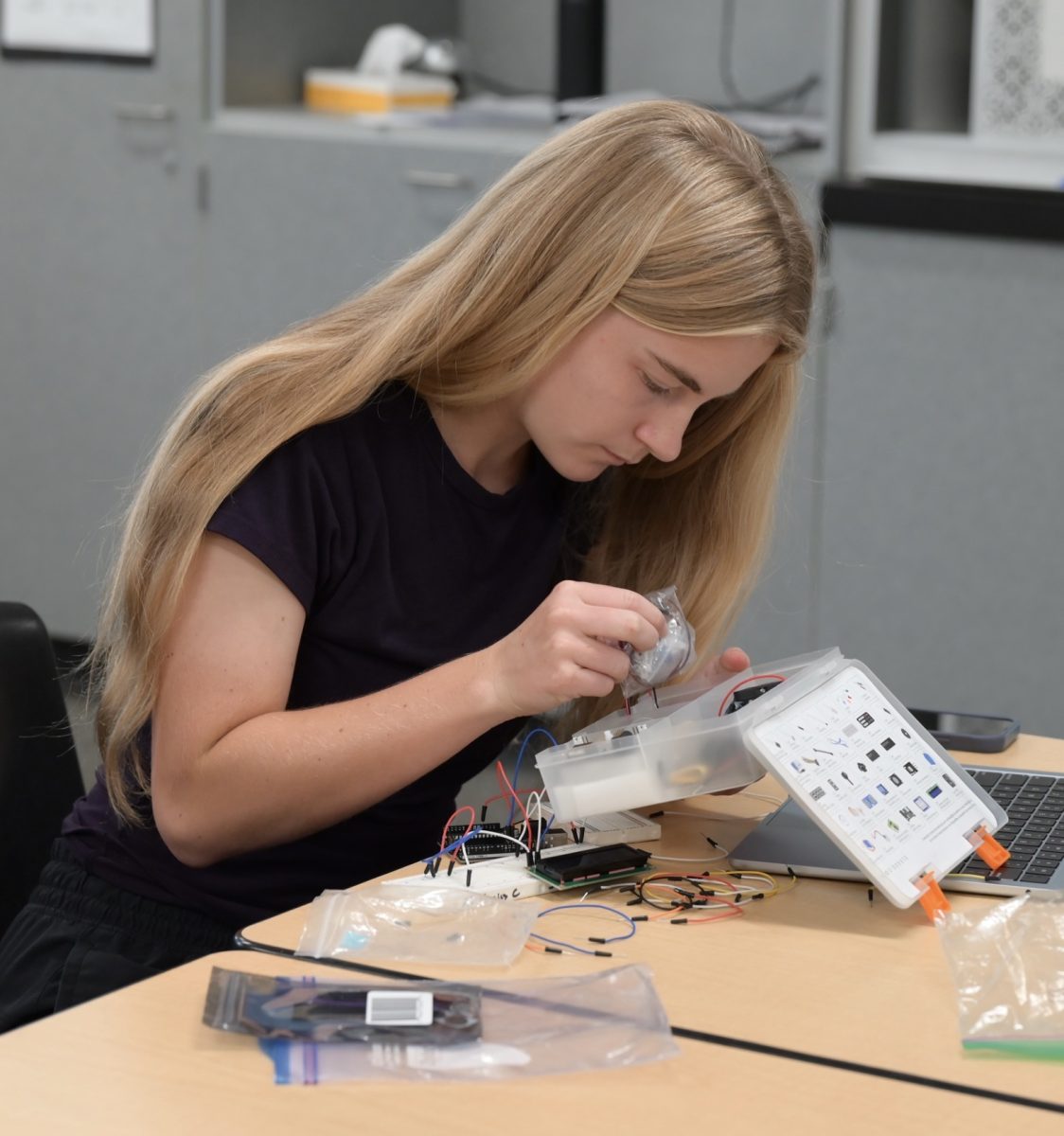
Participants of the Heartbeat Monitor Project gathered one last time to finally assemble their finished monitors, Feb. 9. They gathered all the pieces, first assembling the pulse sensor, the external part of the monitor that directly measures the heart rate, then connecting it to the Arduino, the brain of the project. Finally, all the parts were wired up with the breadboard.
Members of the Girls Who Code and Red Cross clubs have been meeting every Monday and Wednesday for the past four months to build heart monitors from scratch. Lindsay He (12), an executive member of Red Cross, and Claire Zhu (12), the president of Girls Who Code, gathered resources and provided them to each member at the beginning of October.
He and Zhu started planning this project last summer. Their shared experience and interest in biomedical engineering sparked an idea for introducing students to its basic topics.
“This initially started when me and Claire [decided] to do a project together with our clubs,” He said. “I was really interested in biotech, and Claire had a really strong background in engineering and coding. Over the summer, we invested in Arduino kits and a pulse sensor and worked on our own prototype. We figured out [how] to debug the code and [to] connect everything to the Arduino on our own. We probably watched 10 tutorials and transferred the contents into a simple, easy lesson for members.”
He said one of the reasons they ran the project was to help others gain exposure to the field of biomedical engineering.
“A lot of people don’t really have exposure to working hands-on with career-applicable engineering projects,” He said. “I think this was even one of my first gateways into engineering. I’ve never had a [chance] to work out with things hands on. I wanted to combine it with the medical field because [technology] is a huge part of the medical field today. I’m glad we were able to help break things down a little bit and get them introduced to the field.”
In recent weeks, instructions about building the monitor were provided by the executive board. He said the project ran longer than expected, but she was happy to let the students have more time experimenting with the materials.
“We first started on building and then coding,” He said. “It obviously went really long, but I think I managed to do what I wanted to do, which was to make sure that technology was more accessible for people who didn’t initially have much interest in it. I wanted to explain things in a very detailed but also hopefully not a confusing way.
A total of 10 people participated in pairs.Being able to fund the five sets of materials was an obstacle He and other members of the clubs had to overcome.
“Figuring out financial matters was pretty difficult,” He said. “We ran into some problems like finding a good pulse sensor that was not very expensive. We have to work around the fact that each one was around $30. So then, we decided to make this a donation-based project. Every person would find a partner, and they would each pay $15. We collected the donations over a period of a couple of weeks and used that money to [fund] the project.”
A participant of this project, Camrynn Beal (10), is a member of Girls Who Code. Beal decided to join the project in hopes of gaining more skill in coding and electrical engineering. She said the detailed instructions and explanations throughout the project helped her digest the information easily.
“The slideshows definitely helped to understand why you’re doing what you’re doing,” Beal said. “I like how they incorporated the information because a lot of times when doing Arduino projects, no one really tells you why you’re doing something. That’s what I liked about this project, although even if you don’t fully understand it, generally you can just follow the guide without needing to know all the information.”
Beal said the project was a great opportunity to gain hands-on experience in biomedical engineering.
“I got a better understanding of the different Arduino pins and what they each do,” Beal said. “A lot of it was explained in the slides. I think the program did a good job on educating people and helping them understand coding better. I definitely will be doing more projects similar to this after this one.”