
With piles of work and never-ending deadlines, Folklore Club President Serena Lee (12) found herself stress-eating, trying to find balance between schoolwork, extracurriculars, and personal life. Her pairing of food and work through the stress sparked her idea to connect food with folklore mythology through a cookbook.
“When I started Folklore Club, I wanted to connect the whole campus community because a club connects a certain community on campus, but I wanted to go beyond that and connect everybody,” Lee said. “A cool way to do that would be through making a cookbook because everybody is connected through food.”
Reaching out to clubs around campus, Lee brought nine clubs along on the six-month-long cookbook journey. Various culture clubs as well as American Sign Language (ASL) Club and Creative Writing and Performance Club participated. Folklore Club members wrote myths, connecting folklore with the foods and cultures.
“I asked every club to send two delegates to join a cookbook committee who could tell their clubs what was necessary [for the cookbook],” Lee said. “They also proofread the myths we wrote to make sure everything was right because I don’t want someone to read it and think it’s misrepresenting who they are.”
In addition, the cookbook was able to include deaf culture and creative writing through inviting other clubs on campus.
“ASL club did finger spelling for [titles of] every recipe, and our Creative Writing and Performance Club helped write out more than half of the myths,” Lee said.
The cookbook project had been in conversation since May, but the clubs really got to work in September, sending in recipes, writing the myths, and designing the book.
Lee described the connection between food and mythology, sharing how she encourages her club members to explore how myths might affect their own lives.
“For me, looking at mythology, that all comes from the past,” Lee said. “When looking at recipes, there’s something similar with it where even though it was built from the past, we can still apply it today in that I can go home and I can make one of these recipes and it will still enrich me today. I wanted to make that connection, how even though [mythology] might seem far away, we can still find applications to it in our life today, just like recipes. In my club, we’ll always discuss a myth’s takeaways. There’s always something that you can take away, and it might not taste as good as a recipe, but it still sweetens your life.”
In total, the cookbook included 13 recipes, with each culture club providing up to three. Russian Culture Club President Karoleena Maritzashvili (11) said she wanted to represent the diverse community that spoke Russian outside of Russia.
“The recipes my club contributed were Borscht, Armenian Gata, and Georgian Khachapuri. We chose these recipes because they’re dishes everyone can enjoy and make,” Maritzashvili said. “Many countries also speak their language, as well as Russian, and have their own distinct foods and cultures. We wanted to highlight that diversity and include recipes from Ukraine, Armenia, and Georgia.”
Maritzashvili said the project intrigued her when Lee first pitched the idea, wanting to showcase the many cultures present around campus in a special way.
“The main reason I decided to join the Folklore Club in creating this was because I think it’s important to learn about different cultures in unique, engaging ways, whether through folklore stories or, of course, delicious food,” Maritzashvili said.
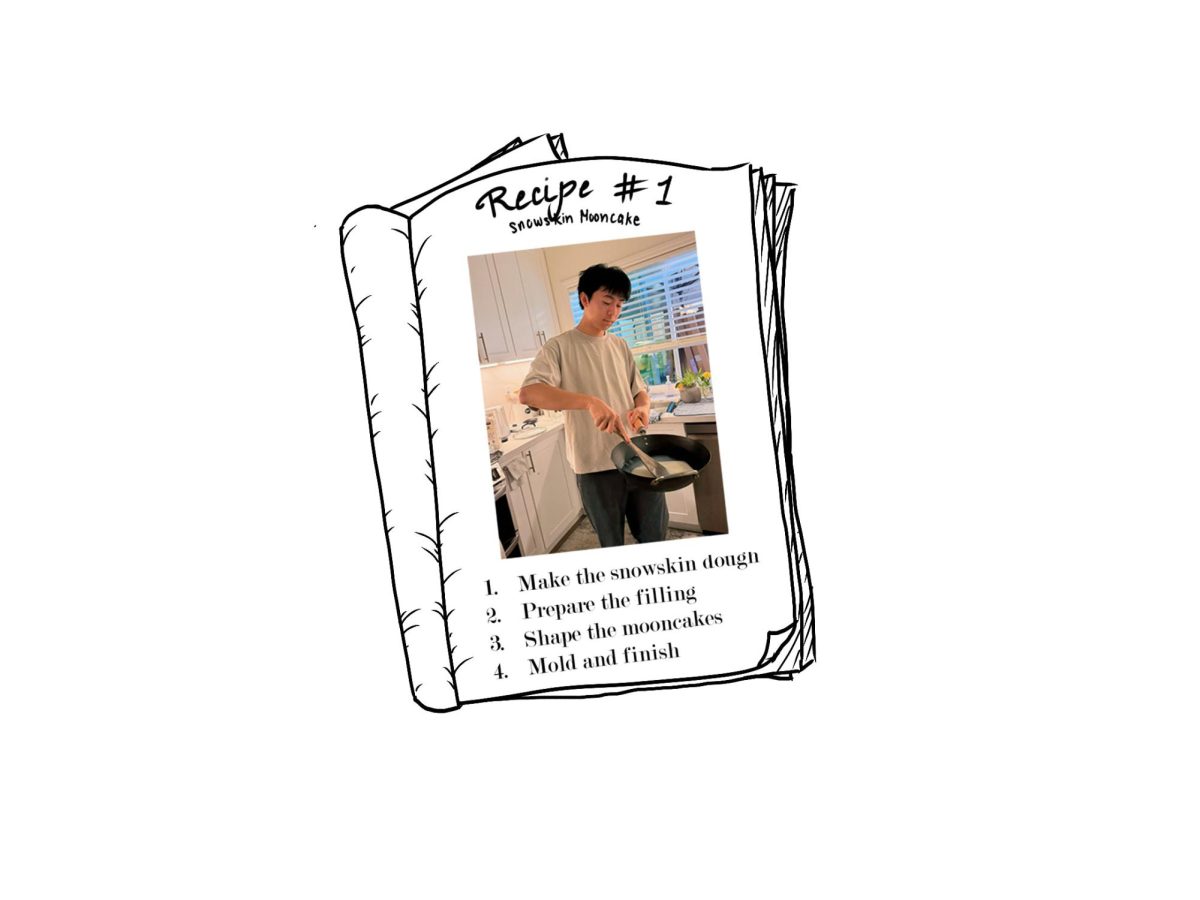
Another contributor to the cookbook, East Asian Student Union President Brandon Tran (12), provided a snowskin mooncake recipe, but encountered a tedious process of trial-and-error when testing out the recipe.
“Making the [mooncakes] was kind of time-consuming,” he said. “It took me six hours in total. The challenge was actually being able to always get the correct recipe because I had to make four batches. The first batch I made was a sticky one, so when I tried to roll it, it always just stuck together and didn’t form the mooncake shape. Then after that, I was able to add more flour, so it’s more consistent.”
While the culture clubs provided the recipes, Folklore Club was responsible for the design process. Lee said she had her eyes set on releasing the cookbook by October, but as a senior, she also had to balance college applications.
“Initially, I thought that doing all the designs and [meeting] the deadline that I set would overwhelm me,” Lee said. “But when I was designing it with my friend, it actually gave me a chance to breathe and just spend time with people I really clicked with.”
Releasing the online cookbook right on the deadline, Oct. 31, Tran shared that the most exciting part of the whole experience was seeing the end result.
“The main thing was seeing my recipe in there,” Tran said. “I think that’s a really good aspect of it, like you’re able to share all these different cultures and folklore through one book.”
Through this cookbook, Lee was able to achieve her goal when founding Folklore Club: connecting students across campus.
“It was really cool to see that different people across campus cared about not just food and mythology, but connecting people,” Lee said. “Even though it’s easy to submit a recipe, every recipe has much more behind it. There was so much work that was put into [the cookbook], with the clubs collaborating and the different aspects that came together to make it possible. I think it was super rewarding to finally be able to see it all pay off.”