

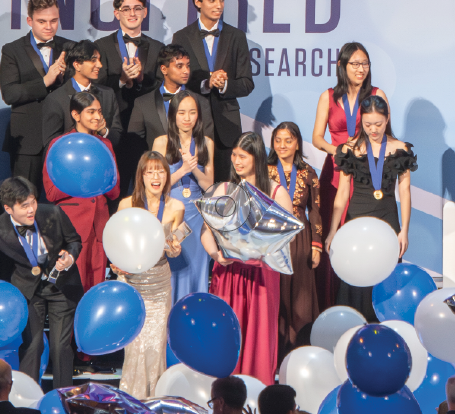
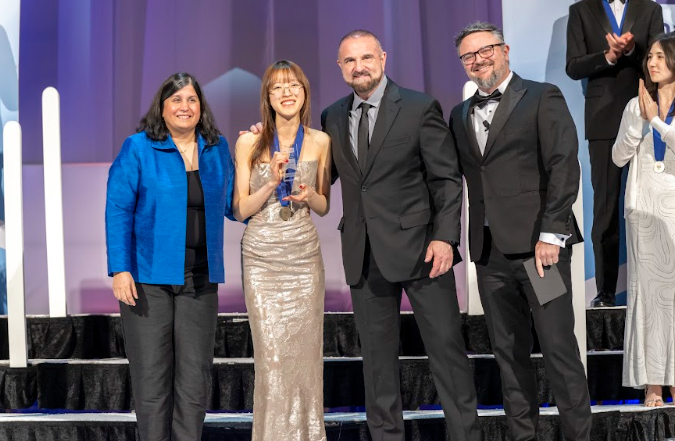
As Leanne Fan (12) stood on stage among the other finalists at the Regeneron Science Talent Search awards ceremony, she felt a mixture of awe and excitement, March 10. In the audience stood hundreds of scientists, from Nobel prize winners to leaders of major scientific institutions. For the past week, Fan had competed against 39 of the nation’s most promising young scientists, people whose research had the potential to change the world. So when George fD. Yancopoulos, CEO of Regeneron, called her name as the sixth-place winner with a scholarship of $80,000, Fan said she couldn’t believe it.
“I was so sure that I would not win, so I wasn’t stressed at all, and I was just interested in who would actually get top 10, not worried about myself,” she said. “I was just in disbelief because I didn’t consider myself one of the top 10 because I didn’t think I did that well in judging, and I guess I don’t have enough confidence in myself and my abilities. I felt like everyone else had so much more knowledge, so much more intellect and critical thinking skills that I didn’t have, so I was really surprised.”
The Regeneron Science Talent Search is the oldest and most prestigious science competition in America for high school students. This year featured the most competitive, largest pool of applicants in nearly six decades. 2,612 students applied, and 300 were selected by judges. After sending in essays, a research paper, and a personal video, 40 of the top students were chosen to go to Washington DC and compete for $1.8 million, March 5-11.
Fan said that San Diego usually has a few people who make the top 300, but it’s rare for someone to make it to the top 40.
“I was editing articles in The Nexus, and I got a call, and I went outside, and they’re like, ‘You got selected as a top 40 scholar,’” she said. “I was so excited and happy because I genuinely didn’t expect it.”
At the competition, the students went through two rounds of judging. The first was composed of six judging panels, where competitors faced a series of questions by three judges from different fields of study. They determined who could think the fastest and the most in-depth, have the most scientific knowledge, and could reason through complicated problems that they didn’t know the answer to.
“They’re trying to judge how you as a student [can] think through problems that seem insurmountable,” Fan said. “They’re trying to find a good scientist, and I think their definition of a good scientist is someone that when presented with this large problem with seemingly no solution, are they going to give up and then just give a random answer and feel like there’s a big wall, or are they going to surpass that wall and then continue to try and use information and persist through that question.”
The judges ask questions from any field of knowledge in all sciences, with only five minutes for each question, which Fan said made it impossible to prepare for.
“They ask you these really hard questions like ‘What percentage of your genome is from a retrovirus,’ she said. “So then you have to figure out what’s a retrovirus or make an educated guess and then figure out what percentage of your genome is retrovirus and why, and explain to them. They don’t ask you questions in your field of knowledge; they asked questions about quantum physics, too, which my project is not about. That’s definitely one of the most stressful parts. You’re kind of expected to just go out, and then whatever knowledge you have is whatever knowledge you have. I thought I did so bad because a lot of the questions I wasn’t able to get an answer to, but I think the reason I was able to still do well in the competition is because I was really clear with my thought process, and they’re able to see how I think.”
The next round of judging involved the competitors presenting their projects to the judges. For her project, Fan used photobiomodulation to heal wounds under simulated microgravity. She tested her research on planarians, tiny worms that can regenerate any body part, and on human cell cultures. Because wounds heal poorly in space, Fan wants to use her research to aid in future space travel.
“They ask us very targeted questions about our project because, unlike other science competitions, they know our research very well, so they try to scope out our limits,” Fan said. “They were asking me these really difficult questions that I’m not used to, but it wasn’t too bad for me because I know my project so well to the point where I think I can answer any question in that realm, but anything outside the scope of my project is kind of hard. One judge asked me a question like, ‘how do planaria store fat and energy,’ and I don’t really know, but I can assume from prior knowledge that maybe it’s through glycogen because other animals store it in glycogen in their cells.”
Fan said that these hard questions made her think on the spot, something she said challenged her view of the world as a scientist.
“It gave me a new view of science and how scientific thinking works because I realized that a lot of the questions we ask can be broken down into basic foundational scientific concepts,” Fan said. “If you think of why tape is sticky, you can pretty much reason through that by thinking about intermolecular forces and the properties of the materials. I think the way I see the world now is really different because I used to think of a question and not know the answer and just ignore it, but now if I’m asking myself, ‘Why is this marker orange?’ I can pretty much have a good hypothesis for what the answer is without having to search it up. I think it’s an interesting skill because it’s how a lot of big science discoveries are made, so I think it opens up a lot of possibilities. I also think it’s something they should be teaching in general education; you learn these topics, but you never really connect them together. This method of thinking really forces you to connect these different aspects about the world together, and you get a better understanding of how our world functions.”
Fan’s knowledge of science was further expanded in between judging sessions, where she interacted with the other finalists, whose projects spanned a wide variety of scientific fields.
“You get to talk with the other finalists and learn about their lives, and it’s interesting because they’re from all different places in the US, so you learn about how they view science,” Fan said. “One of my friends is doing theoretical physics, for example, and he was teaching me about the different quantum states over breakfast, which was really surreal, and then in another conversation, another friend was talking about their research on cryptography or discovering new planets based on their metal composition or mathematical spin states of particles and discovering new shapes and stuff. I never learned so much about the different fields of science before now, and I realized how vast science is after meeting these people.”
Regeneron Science Talent Search is one of the biggest predictors of scientific impact in the future, and it has produced the most Nobel Prize Winners and MacArthur Fellows. Fan said that it was inspiring to think of the young scientists there who could change the world someday.
“The things that have been invented by alumni of the science centers have genuinely impacted the entire world,” she said. “For example, we met Ted Hoff, the inventor of the microprocessor. He was in the exact same position as us decades ago and invented something that drives the digital age. I was really surprised by how important the competition was, and I never really realized the impact it had until I went there. I think being surrounded by the other 39 finalists was really surreal because you know the history of the competition and the impacts that previous alumni have made. It’s this feeling that a lot of the 39 people around me will be making these scientific impacts that can change millions of lives, and also someone might become a Nobel Prize winner or discover something that maybe lets us go to distant planets, or go to Alpha Centauri, or maybe they’re going to find some answer to renewable energy.”
Fan got to meet important scientists, like directors at museums, CEOs of big pharmaceutical companies, and famous inventors. She said that having conversations with these people was her favorite part of the event because she got to hear different perspectives about being a scientist.
“I learned about what it means to be a good scientist, which I never really understood before,” Fan said. “One of [the things I learned] is that you don’t have to take a straight path. Everyone I talked to, I asked for their life story; no one had a straight path. A Nobel Prize winner invented something in biochemistry, and he started out as an engineer. Another person from Regeneron who is in business right now started off as a scientist. Another thing I learned is that to be a good scientist, you have to ask questions about the world and be willing to pursue them and persist beyond any barriers you have. Also, surround yourself with people who can build you up like a team. The Regeneron CEO’s biggest piece of advice was that to be successful, it’s not just about you, but it’s [about the] people around you and how you can recognize talent and then build off of other people’s talent, which is how a lot of scientific discoveries have been made. These pieces of knowledge I can take with me throughout life and college, I think, are really valuable, but also the message they kept telling us is [that] the value of the competition itself is not the award or the money, it’s the friends we made along the way.”