

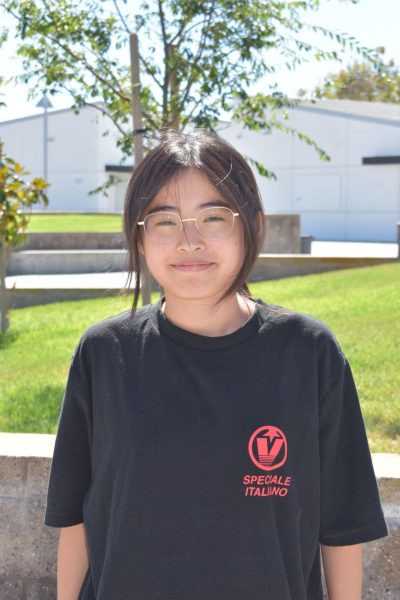
For most students, science experiments stay inside the classroom. For Jocelyn Cotton (11), they take place knee-deep in a lagoon, surrounded by cattails and sunlight. With a water testing kit in one hand and a bucket of samples in the other, Cotton spends her weekends helping to protect one of San Diego’s most vital ecosystems—the San Dieguito watershed.
“I always just loved being in nature and around it,” Cotton said. “When I was little, my family would take me to national parks, and I really enjoyed spending time there.”
That childhood curiosity eventually turned into something greater. At 13, Cotton joined the research cohort in the Conservation Environmental Stewardship Apprentice Program (CSAP), an apprenticeship offered through the Ecological Institute. The program teaches students real-world conservation skills, from ecological research to community outreach.
Each month, Cotton and her team visit different sites around the San Dieguito watershed, including the San Dieguito lagoon near the coast. There, they collect water samples to test for pH, dissolved oxygen, phosphate, nitrate, and fecal coliform bacteria—all important indicators of water health.
One of Cotton’s main responsibilities is measuring how much dissolved oxygen is available for aquatic life.
“I fill up the ministry test tube all the way, drop in two [chemical reagent] tablets, then I kind of shake it up and down until the two tablets dissolve,” Cotton said. “Then you take the temperature and the color of the water, and you compare those on the chart, and it gives you your percent saturation.”
The process provides significant insight into the health of the water lagoon. During a recent test, Cotton and her group discovered unusually low oxygen levels, a sign of poor water quality and overgrowth of algae.
“It was surprising to find low levels of dissolved oxygen,” Cotton said. “It made me realise how sensitive ecosystems are and how it can seem fine but not really be fine at all.”
Last year, Cotton and her cohort began writing a research paper summarizing their findings on the San Dieguito watershed’s health, which will be published by June of 2026.
“I hope that this paper will show readers the importance of water quality and how to take care of your community watershed,” Cotton said.
Through CSAP, Cotton said she has gained both lab and field experience as well as a deeper understanding of environmental responsibility. She said the work has helped her see how everyday actions, such as washing cars or using fertilizers, can directly impact the health of local water systems.
“Locally, the biggest threat is urban runoff, which is things like fertilizers from golf fields, agricultural runoff, soap, so that runs off into the watershed, and it always impacts the watershed and harms it,” Cotton said.
This awareness has inspired Cotton to take action and plant her own garden, made entirely out of native plants. Indigenous plants act as a natural filtration system, storing pollutants in their roots as they wash over the soil, effectively reducing the chemicals that get washed into watersheds.
“Native plants naturally filter out these pollutants,” Cotton said. “So my dad [and I] are actually about to plant a native plant garden in our backyard.”
Her environmentalism has extended beyond her research, even altering her everyday lifestyle. Cotton recently decided to become a vegetarian as another way to reduce her environmental footprint. She said that learning about the impact of agriculture and animal products on the planet motivated her to make the change.
“I would say it has taken my view of protecting our environment from a passive sense [to a] more active stance,” she said. “I actually know things now that I can do to take steps and protect the environment.”
This understanding is exactly what the Ecological Institute hopes to foster in young scientists.
Beyond the data and fieldwork, what stands out most to Cotton is the sense of purpose the program has given her.
“It really shows me how responsible we are for the quality of our watershed, and the water we drink, the water we use,” Cotton said.
Going forward, Cotton said she hopes to see more people take small steps to better their local environment.
“I would love to see people just making small changes,” she said. “It doesn’t have to be something huge, just doing something simple every time, making a small sacrifice in order to protect our resources.”



Michelle Lee • Nov 22, 2025 at 11:20 pm
This was such an interesting read! As someone who is thinking about minoring in environmental science, I found Cotton’s experiments super interesting. I’ll be on the lookout for that research paper. I really enjoyed reading this one, Junjie, keep it up!! (I also liked your anecdote at the beginning.)