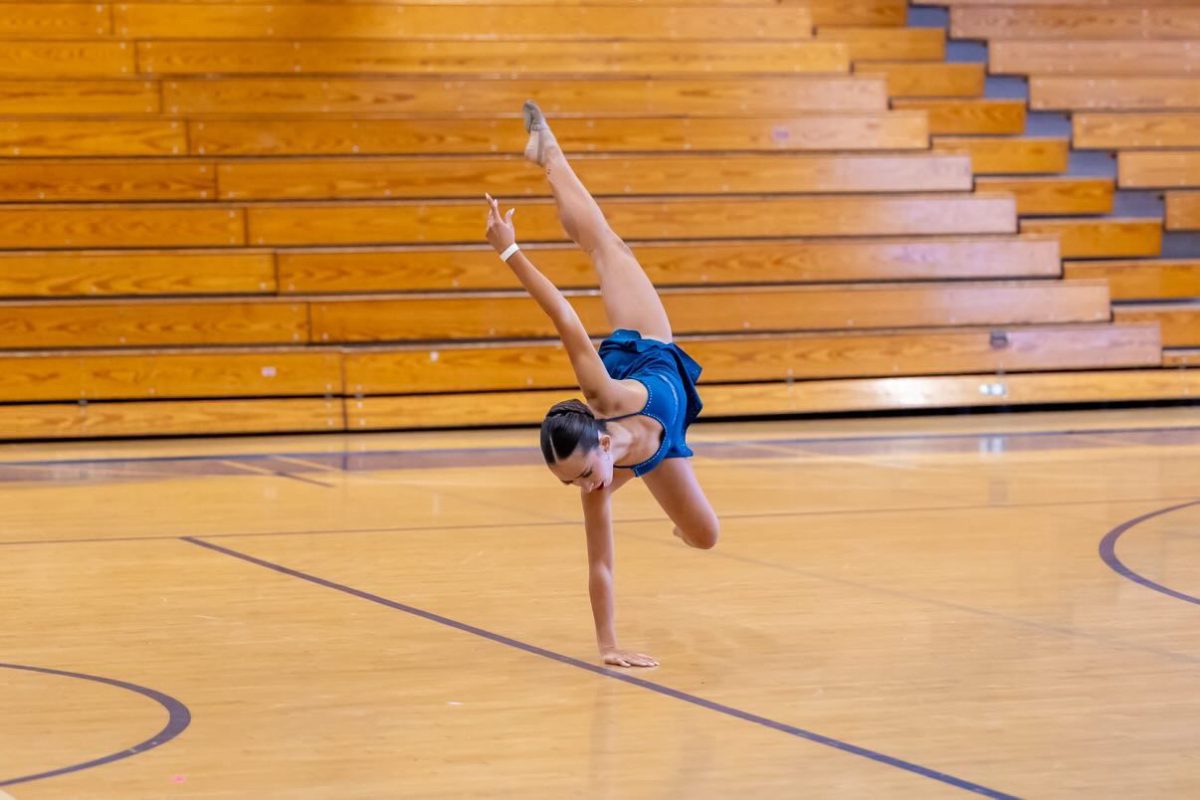


Joyce Chen (11) stood on the spring board, shaking the chalk off her grips. She faced the uneven bar set, one of the four gymnastics apparatuses, taking one last deep breath to calm her nerves before jumping to start her routine, April 30.
The first half of her routine, which she performed on the lower of the two bars, went smoothly. Chen was more worried about her final skills: her giants, a skill where she had to make a full swing around the bar in a straight-body position. She completed her handstand on the bar, reminding herself to do a strong tap, a quick change of body shape from an arched position to a straight body position that generates power for the giant. Chen felt the air whooshing around her as she came down from the bar, and suddenly the butterflies returned to her stomach. In that moment of competition, where pressure merged with fear, Chen’s confidence faltered.
Chen is not alone in these fears. Unexpected injuries and mental blocks on skills are two of the most difficult obstacles that gymnasts face. According to Chen, gymnastics is a very mental sport, meaning that learning new skills doesn’t only require strength and the right technique, but also confidence and trust in one’s own abilities.
The helpful reminders in her head were quickly replaced by anxious scenarios of her giants going wrong: she might hit her shins on the low bar behind her, or slam her feet into the mat below her. But worst of all, Chen feared that her grips could slip.
If that happened, her momentum would cause her to fly off the bar and crash into the ground, smashing her back into the floor. In this moment, Chen’s fear quickly took hold of her mind, making her lose focus. Her tap wasn’t strong enough, and instead of swinging over the bar, her body stopped right on top of it. Chen had no choice but to let go, falling onto the mat below her safely.
Her heart was pounding, but she knew she had to shake it off and get back up. Chen only had one more chance to complete her giants. Out of the corner of her eye, she saw the judge put up a 30-second timer; that’s all Chen would get to calm her mind. She fixed her grips, taking deep breaths as she re-applied the chalk to them. Chen recited encouragements in her head, telling herself that her body knows how to do this skill and that she’s done it a million times before.
She got back up on the bar and felt that familiar fear return before she jumped to the high bar. But this time, Chen ignored her anxiety and repeated reassurances to herself. Again, she completed her handstand and swung down from the bar. Again, she tapped, but this time, she made it over the bar and dismounted onto the mat below her. A wave of relief washed over her, spreading into a wide grin as she turned and saluted the judge.
These persistent fears often made competing difficult for Chen. In this stressful environment, she said she started to doubt her ability to land her skills, causing her to make atypical mistakes.
In gymnastics, Chen said falling on one skill can ruin the rest of the routine because it plants a seed of uncertainty that sprouts throughout the rest of the meet. But if she does end up falling, Chen tries to not let it affect her performance.
“I just try to forget about what already happened because what’s done is done,” she said. “If I already fell, there’s nothing I can do about that. Since we get 30 seconds to get back up on the beam or bars, I try to start thinking about what I want to do for the rest of our team.”
Practices also generate stress for Chen. When she has to practice her giants on bars she said she often deals with doubt, which leads her to stop practicing some of her skills.
“A lot of times I’ve had scary falls,” Chen said. “Then whenever I go to practice, I’ll avoid them, which makes it worse.”
However, Chen has learned from these experiences and has found a way to get over this fear. After a particularly scary fall, she gives herself enough space to calm down and remind herself that her feelings aren’t unusual.
Chen also gives herself mental cues during her skills to affirm her confidence in herself.
“I remind myself, ‘hit a good handstand’ and then [think], ‘don’t worry, you got this’ as I’m [swinging] down [from the handstand],” Chen said. “I remind myself to be strong and have a good [swing]. Then I tell myself, ‘you got this’ at the end.”
According to a study done by the National Institutes of Health (NIH), positive self-talk causes athletes to experience a lower level of anxiety and a higher level of self-confidence before competitions. The NIH also concluded that high amounts of anxiety caused lower performance in athletes.
To overcome the mental blocks she faces, Mayuri Ishitsuka (11), another gymnast attending Westview, tries to work with her fear rather than against it.
“Instead of pushing through that fear, [I] respect it and [that] it’s an instinct that we’re born with, it’s meant to keep me safe,” Ishitsuka said. “I don’t shame myself for being scared, but at the same time I reason logically, like, ‘I’ve done this before’ or ‘I know how to fall.’”
One skill that she had to learn to work with was her standing back handspring on beam. Ishitsuka said it felt like there was a brick wall behind her and when she flipped, she would imagine herself slamming into it. This fear prevented her from landing her back handspring. Rather than forcing herself to do this skill, she took a different approach, realizing that she has flexibility when it comes to choosing what skills she competes.
“I don’t necessarily have to do what everyone else is doing, and I don’t necessarily have to follow the set ideal path to be successful,” Ishitsuka said. “I think that’s what I really like about gymnastics. It’s adaptable.”
For Ishitsuka, fear can manifest itself in unexpected moments and during skills she’s comfortable with. During one of her dismounts on beam, she froze in the middle of her skill and nicked the back of her head on the beam. This could’ve negatively impacted her confidence with the skill, but she found a way to prevent scary falls from affecting her.
“I try to create a positive response so that my body doesn’t freak out,” Ishitsuka said. “If I started crying, then my body would be forever traumatized, and I would never try that skill again. But I try to laugh or find something I did well in that turn, even though it was really scary.”
Injuries have been a big obstacle for Ishitsuka as well. She fractured her back in the summer, and despite resting for the doctor’s recommended time of 6 weeks, it did not heal properly. Often when Ishistuka lands her vaults, she feels a sharp pain in her lower back that she said it feels like being stabbed. Still, she manages to find a way to work through the pain, similar to how she handles mental blocks.
“I think about one skill at a time,” Ishitsuka said. “Normally, it’s, ‘Oh, I just need to get through this. I need to get through this.’ I keep thinking about one skill at a time, so that it doesn’t seem like such a daunting task. It breaks down the complexity [of the routine.]”
Competitions aren’t the only place Ishitsuka needs to have a positive mindset. Returning to practice after a long injury affected her confidence in gymnastics. Because it had been a while since she had practiced, she felt like she had to relearn her skills and that she wasn’t as proficient as many of her teammates. But Ishitsuka said having a good support system of coaches and peers who have gone through a similar experience helped her get back to training with a positive mindset.
“I struggle a lot [with] getting back from an injury, because I have to start over again and relearn so many skills and it feels like I’m so behind,” she said. “[It feels like] everyone else is surpassing you constantly. That’s really frustrating to me. [But] I try to zoom out and think about [how] I am improving. I have improved more than last turn, so it’s okay that I’m going at a slow pace.”