


As the curtains rose and the dancers glided onto the stage, West Coast Dance Complex’s one-night performance of The Nutcracker began to unfold. With all the dancers celebrating in the Christmas Eve party that opens the show, it seemed like all the performers were there. Yet beneath the stage, hidden from the lights above, Veronica Xu (12) and the rest of Winecreek Ensemble watched their conductor intently, waiting for him to signal the beginning of the pit orchestra’s first song, Dec. 7.
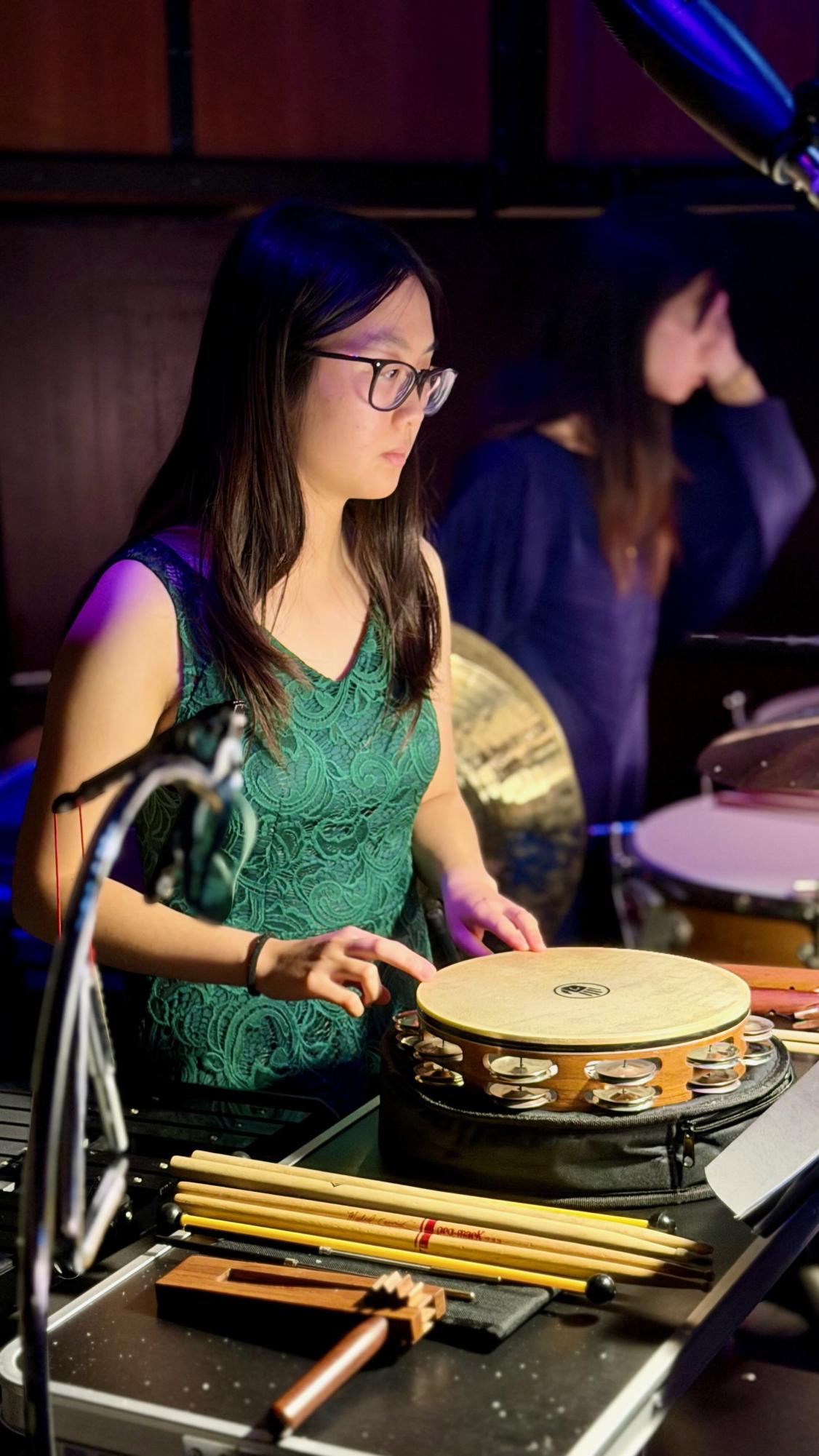
Xu said that performing in the pit with an ensemble made up of adults and teens was a surreal experience. But as soon as she started playing the triangle, her nerves quickly faded.
“It’s very professional, and I’ve never played in this type of theater before, so when I first went in there, I couldn’t believe I was doing this because I’ve literally just learned percussion two years ago,” Xu said. “I felt like I didn’t fit in [to the professional environment], but when I started playing, I was like, ‘I made it there.’”
Violin player Siddhi Bhavsar (10) said that since the performance was held at the California Centre for the Arts Concert Hall, a venue known for its acoustics, the sound echoed beautifully throughout the hall.
“The music sounded a lot different because our rehearsals without the ballet would be in this small ballet room where we’d all be jammed up, and in the concert hall, our sound was able to project outwards,” she said. “When we started playing, you wouldn’t expect our sound to fill the room so well, but it really did. It echoed in just the right way that it filled the room really nicely.”
This was Siddhi and her twin sister Riddhi Bhavsar’s (10) first year playing for Winecreek Ensemble, but their background playing the violin began at 5 years old.
However, although Xu joined the ensemble as a sophomore intending to play piano, the instrument she’s been playing for 9 years, she realised that there weren’t any piano parts, so she started learning percussion. In The Nutcracker, she had to learn the timpani, triangle, tambourine, glockenspiel and cymbals.
“It was very scary,” Xu said. “The first rehearsal, I missed like every single cue because I didn’t know how to read the music. So after the first rehearsal, I needed to bring everything home and practice, so I took all the instruments they put in this giant box home, and I practiced on my own and listened to the music. I practiced a lot of rhythm stuff, so I had to count the music out loud so I could hear it clearly.”
While Xu’s years of piano playing helped her grasp the new instruments faster, she said that learning percussion actually contributed to her piano skills as well.
“When I played piano, I [felt] like my rhythm wasn’t that good, so after percussion, I think it actually improved my piano skills more, not the other way around,” she said.
According to Xu, one especially complicated piece to play is the song “Gingerbread,” which requires her to play the timpani on offbeats.
“That part has a lot of syncopation; it’s offbeat,” she said. “So when you’re counting, it’s in twos. You [count], ‘1, 2, 1, 2,’ but you’re supposed to play the timpani on the offbeat, so you’re counting 1, and then you’re playing [on 2]. So it’s hard to keep it steady for the entire piece because the ensemble changes speeds a lot.”
Siddhi said that playing for The Nutcracker was a different experience than normal concerts because the ensemble also had to keep the ballet dancers in mind.
“The day when we started working with the ballet, that was two weeks [before the performance], it was really interesting to see how the leader for the ballet company [would say] ‘Can you slow the tempo down or can you increase it?’” she said. “And we just had to adjust to that based on what they want because they’re the main performers and we’re just behind them.”
During the actual performance, Riddhi said it was interesting not being the audience’s main focus.
“When we perform as an orchestra, we’re usually on the stage and not underneath,” Riddhi said. “There were definitely certain people who could see us over the ledge of the pit, but it was very much different to not be the main attraction, especially because there were certain times in the music where people would clap over us. So we were playing something, and something really cool would happen in the dance, no doubt, and they would just clap over us, and we’re like, ‘Oh, I can’t hear us anymore now.’”
Still, once the show was over, Siddhi said she was proud of herself and the other members of the ensemble.
“It was a great achievement,” she said. “It was really different than anything we’ve done before, and it was like finally the hours of rehearsals that we’ve gone through and then the five hours before the main thing that we were practicing, it all came together, and it paid off, and everything worked out really well. It was really well done, and it just felt good.”
Xu said that because the people in the ensemble were so supportive, the group became a close community to her that pushed her to grow.
“Everyone is so nice and so welcoming,” she said. “I was actually really surprised because I thought they were all going to yell at me when I couldn’t play the cymbals, but they were really nice and they actually do care about you. They want you to improve in music, and they’re okay with mistakes.”
Similarly, Siddhi said that even though the musicians in Winecreek Ensemble have a big age range, they are all united by their shared passion for music.
“It was a really great experience,” she said. “It was amazing to be able to work with such great musicians and to be in a more casual environment with music. We all share the common passion of [wanting] to share our music with others, and this is a really great way for us to all do that. We get a community with a lot of people who think kind of like us, even though they’re all different ages, different backgrounds. It’s a huge variety of people, and it’s great to see us all come together under one common passion and goal.”